Introduction
In CDM 2015, the HSE defines the role as that of a designer, who may be an organisation or an individual, that a client appoints in projects involving more than one contractor. They plan, manage, monitor and coordinate health and safety in the pre-construction phase of a project.
The principal designer plays a key role in influencing how a project’s health and safety risks are managed. Pre-construction design decisions can significantly affect whether the delivery process safeguards everyone involved, including those who later maintain the structure or work in it.
A principal designer does not have to carry out any design work on the project, but they must be a designer, as defined by CDM 2015, and have control over the pre-construction phase. The appointee must possess all the relevant skills, knowledge and experience – or, if the principal designer is an organisation, the collective capacity – to perform all of the role’s functions.
As soon as it becomes reasonably foreseeable that a construction project will involve two or more contractors, the regulations require the appointment, in writing, of a principal contractor and a principal designer.
This requirement applies equally to small building projects – even a simple house extension is likely to involve at least two contractors. But, if the homeowner – i.e. a domestic client, rather than a commercial one – in such a case fails to make a formal appointment, the principal designer role automatically passes by law to the designer in control of the pre-construction phase – e.g. the architect or lead designer. Similarly, the principal contractor role will go to the contractor in charge of the construction phase.
CDM 2015 requires the principal designer to be in control of the pre-construction phase and lead the management of design risk where design work is involved. In most cases, the organisation serving as lead designer will be best placed to take on this role, given its oversight of the design process and coordination of other design matters.
Where a project involves several contractors but little or no traditional design work, a principal designer is still required to oversee the pre-construction phase.
What does a principal designer do?
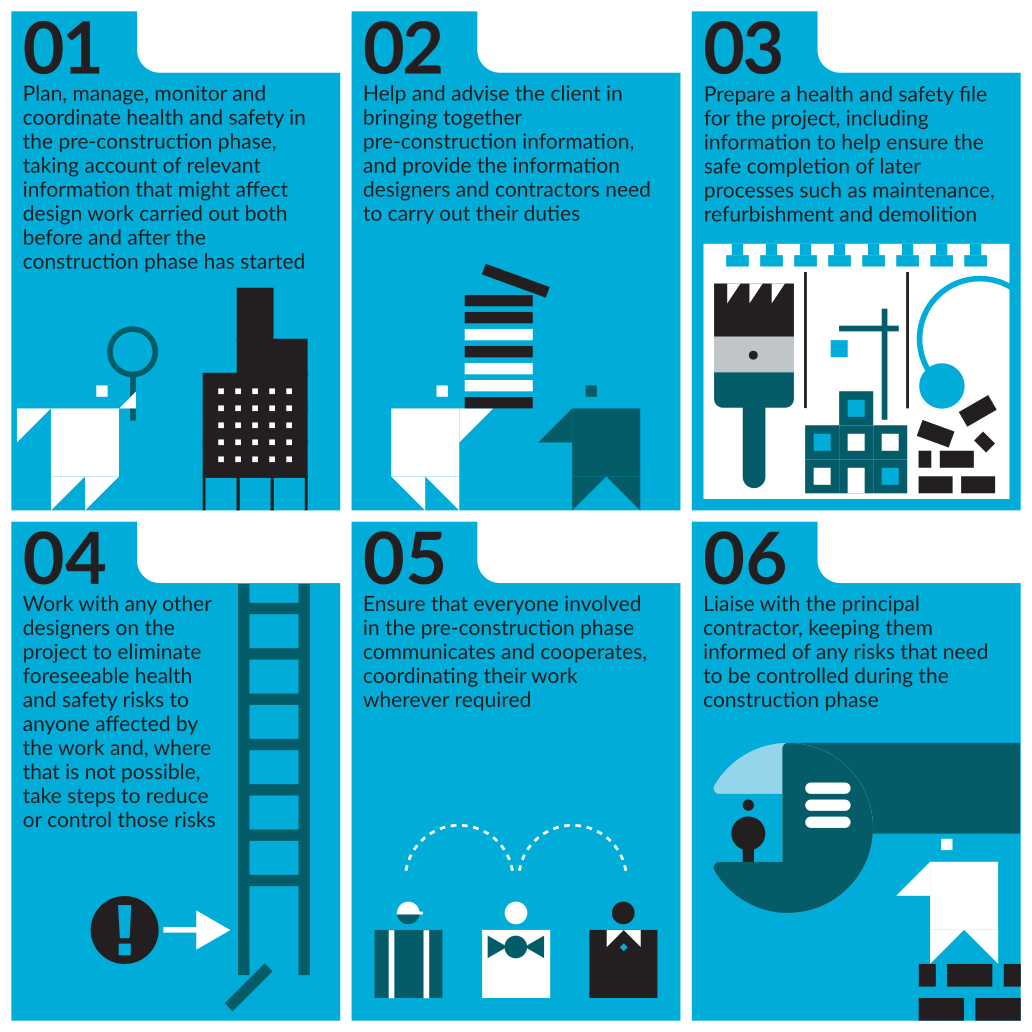
As the diagram above shows, the principal designer must work closely with both the client and the principal contractor. The role also involves coordinating the work of other members of the project team so that foreseeable health and safety risks are managed throughout the design process.
The principal designer should ensure that the design team identifies the foreseeable risks and then eliminates these or, where that’s not reasonably practicable, reduces them through design. It must do so by applying the general principles of prevention set out in the Management of Health and Safety at Work Regulations 1999.
Where a risk cannot be adequately reduced, the principal designer should ensure that the design team provides information about this for the client; other designers and contractors; and those who will use or maintain the planned structure. Appropriate ways to share this knowledge include the health and safety file and as-built records and drawings.
What skills, knowledge, experience and behaviour are expected of a principal designer?
The principal designer’s professional attributes should be appropriate to the type of project concerned and the range and nature of the health and safety risks it presents.
These may include:
- Technical knowledge of relevant construction processes.
- Knowledge of health and safety in relation to the proposed works, and of methods of managing risk through design, such as sector-specific guidance.
- The ability to understand and manage the pre-construction phase (including ensuring that foreseeable risks are eliminated or reduced in the design process) and to manage any design work done after construction starts.
- The ability to coordinate with the client and principal contractor on foreseeable health and safety risks and related controls – and to challenge designers and other specialists where necessary.
- The ability to prepare a health and safety file that includes all of the information needed by anyone who might use, maintain or alter the structure.
Someone might demonstrate their suitability for the principal designer role by becoming a member of a professional institution and recording their qualifications, relevant project experience and continuing professional development activities.
They should also declare any shortfalls in their competence and set out a plan to address these. Such a plan could include undertaking formal training and studying sector-specific guidance. It might also involve engaging more experienced professionals who could be included in the project as independent reviewers to address specific knowledge gaps.
An organisation might evidence its suitability by undergoing third-party pre-qualification assessments, such as those by members of the Safety Schemes in Procurement Forum, or by completing the Common Assessment Standard. It should supplement this by demonstrating that its proposed project team is aware of the applicable company procedures, and that people with relevant knowledge are part of this team or available to it. If it identifies any capability gaps, it should disclose these to the client and implement a plan to resolve them.
All principal designers – or individuals forming an organisation’s principal designer team – must have health and safety expertise, as proven by qualifications awarded by bodies such as the Institution of Occupational Safety and Health and the National Examination Board in Occupational Safety and Health. They also require communication and coordination skills to help them work effectively with designers, the client and the principal contractor on foreseeable risks and controls.
It’s particularly important that principal designers are assertive, because there may be times when they disagree with the design or construction teams’ proposals or need to inform them that the project isn’t ready to proceed.
They must also have good listening skills, so that they can understand the differing views of those involved in the design and make informed judgements. For that reason, project management experience is valuable, as is experience of construction procurement and delivery.
When does the principal designer get involved?

The HSE says the principal designer should be appointed early and stay in place as long as there is a need
As per regulation 5(1) of CDM 2015, “if it is reasonably foreseeable that more than one contractor will be working on a project at any time”, the client must appoint a principal designer as soon as is practicable and, in any event, before the construction phase.
The appointment should therefore be made as early as possible, preferably no later than the concept design stage (e.g. stage 2 of the Royal Institution of British Architects’ Plan of Work). The principal designer should then remain in place for as long as that role needs to be performed.
Even if it’s taking a “design competition” approach to procurement and delivery, the client should apply CDM 2015 from the outset. A conceptual or feasibility design still requires design work, so the regulations will apply from that point.
The sooner the principal designer is appointed, the greater their influence on safety risk management. If the role is filled too late, the appointee will find it hard to reverse key decisions already made in their absence.
Consider the example of a proposed school enlargement. Early project discussions might consider the viability of building in a separate location from the existing premises. Such decisions tend to be made before any feasibility design work starts, but they can significantly affect construction safety, given that many members of the public – in this case, mostly children – could be close to the site. It is therefore sensible to have a principal designer already in place to ensure that decision-makers observe the general principles of prevention when making choices of this nature.
It is important for the principal designer to remain in place to oversee design and preparatory work throughout the pre-construction phase, which can extend into the construction phase. Many projects continue to develop elements of the permanent works design during construction, while almost all require temporary works design throughout. In effect, this means that the pre-construction phase can last for the duration of a project.
How to perform the role effectively
CDM 2015 makes it clear that the principal designer must operate as an integral part of the design team, not as a compliance checker or auditor. The way a principal designer works will vary depending on the size and complexity of the project and the procurement methods used (if the project’s designers are not part of the principal designer’s own supply chain, more formal coordination and communication will be required).
While no single approach will work in every situation, the HSE provides guidance on the regulations and what each duty-holder must do to comply with them and thereby ensure that a project’s health and safety risks are properly managed.
Designers often don’t attempt to minimise certain risks because they consider these “standard” or “within the knowledge of a competent contractor”. Yet hazards treated this way are among the leading causes of fatalities and serious injuries on construction sites. CDM 2015 was enacted with the specific goal of reducing this toll through design. The principal designer is in a prime position to ensure that projects prioritise accident prevention via design risk management.
The principal designer must ensure that the designers of temporary as well as permanent works comply with regulation 9. While temporary works designers may typically be employed by the principal contractor or work within its supply chain, it has a duty under regulation 13(5) to liaise with the principal designer. The principal designer should not have a problem accessing designers within the principal contractor’s supply chain, but early planning will make it easier.
The health and safety file
One of the principal designer’s key duties during the pre-construction phase is to compile a health and safety file for the project. This will contain information likely to be required to manage health and safety risks during later work on the structure, such as maintenance, refurbishment and demolition.
The file might include as-built drawings; details of any hazardous conditions (e.g. land contamination) or materials (e.g. asbestos); key structural principles; fire safety measures; and provisions for the safe inspection and maintenance of the structure. It should also provide information relevant to the removal or dismantling of any installed equipment – for example, approved lifting gear, access routes and the safe working loads of floors and roofs.
The principal designer will also help the principal contractor to prepare a construction-phase plan by sharing knowledge of the following:
- the site, its hazards and the design;
- anticipated construction methods and any restrictions (e.g. safe working loads);
- other project-specific aspects that pose a higher level of risk than normal;
- unusual construction risks;
- any specific sequencing required; and
- expectations for temporary works.
The Building Safety Act 2022’s principal designer role

The responsibilities of design and construction professionals are being reassessed in light of the Grenfell tragedy
After the 2017 Grenfell Tower disaster, the roles and responsibilities of everyone involved in the design, construction and management of buildings came under scrutiny. The Building Safety Act (BSA) 2022, along with amendments to related legislation, imposed new duties on these main parties.
The act specifies several roles and outlines their incumbents’ responsibilities over the life of a building. It gives some of these roles the same titles as those assigned by CDM 2015, including principal designer and principal contractor, which creates potential for confusion. But their duties under BSA 2022 differ greatly because they concern compliance with the Building Regulations rather than safety risk management. The competence requirements of appointees to these BSA 2022 roles therefore vary considerably from those set out in CDM 2015.
Having said that, both the BSA 2022 and the CDM 2015 principal designer roles may be fulfilled by one organisation if it’s competent enough to do so. Indeed, legislators envisage that this will probably become the norm over time.
- Graphic design: Peter Grundy
- Image credits: Luca Onniboni; the blowup