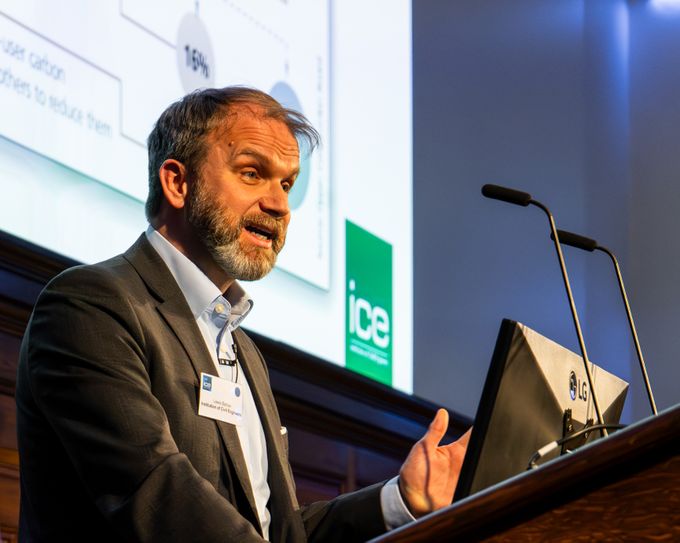
Lewis Barlow called for more systems thinking on decarbonisation at the Digging for net zero event
“The word ‘challenge’ is woven into PAS 2080 – it is repeated about 20 times,” he said. “I think we know in our heart of hearts that the way we’re doing things is unsustainable. PAS 2080 recognises that and says that everyone in the supply chain needs to challenge everyone else… recognising that the system needs to change.
“It’s not just about decarbonising a project – it’s about pulling it all together at a programme level and a system level.”
Carbon management must therefore become an integral part of the procurement process, with “carrots and sticks” included in contracts, added Barlow, who is also decarbonisation head of profession at WSP in the UK.
One important tool for achieving this has been the update to the NEC4 suite of contracts to include a clause containing decarbonisation requirements: secondary option X29.
I think we know in our heart of hearts that the way we’re doing things is unsustainable. PAS 2080 recognises that and says that everyone in the supply chain needs to challenge everyone else
Lewis Barlow, WSP
Avoid, switch, improve
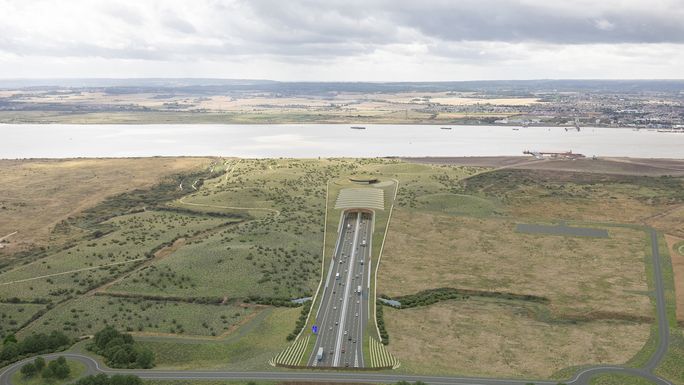
Also speaking at the event was Dr Neil Phillips, principal engineer at COWI, which is working on the Lower Thames Crossing project (LTC). This will build a 23km road linking Kent and Essex via a 4.2km twin-bore tunnel beneath the river east of Gravesend and Tilbury.
“Decarbonisation is an engineering problem we need to embrace as engineers,” he said. “But it’s also a commercial problem – and we must understand how we can make that change right from the start of our projects and drive it all the way through.”
Phillips, who is also a member of the BTS’s Net Zero Tunnelling Group, shared some examples of actions to consider on tunnelling projects under the headings of “avoid”, “switch” and “improve”.
Possible ways to avoid emissions include:
Rethinking the need for features such as cross passages, if they are not safety critical.
Deploying re-usable temporary structures and equipment.
Giving preference to local suppliers.
Possible ways to switch to less carbon-intensive alternatives include:
Using non-traditional building materials with less embodied carbon.
Adopting non-traditional construction methods.
Running machinery on cleaner fuels – e.g. replacing diesel-powered vehicles with electric ones.
Possible emission-reducing improvements include:
Minimising waste by making the materials-ordering process more accurate.
Embedding effective carbon management as a procurement criterion.
Applying the observational approach by gathering real-time data on changes of ground condition, enabling rapid adjustments if it behaves in unpredicted ways.
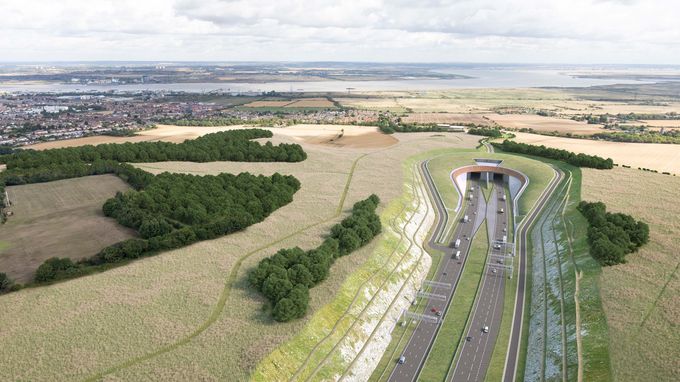
The Lower Thames Crossing is the first major highways project to gain PAS 2080 accreditation. Image credit: National Highways/Joas Souza
Ambitious targets
Phillips recommended that a client should set the right tone by devoting adequate time early in a project – when key decisions have the biggest impact – to explore a range of options and their effects on its whole-life CO2 emissions.
The LTC is the first major highways project to gain PAS 2080 accreditation. It even requires subcontractors to be PAS 2080 accredited, let alone its contractors. Their contracts contain clauses incentivising decarbonisation.
The leaders of the LTC have set the ambitious target of a 70% reduction on the baseline figure calculated for its CO2 emissions. It has been designated a “pathfinder project” for the construction industry by testing innovative low-carbon methods and technologies.
“We are really focused on outcome, rather than over-specification,” Phillips said. “We’re allowing the designers and contractors – the guys who really know how to do this – to come to us with ideas as to how they can drive carbon out.”
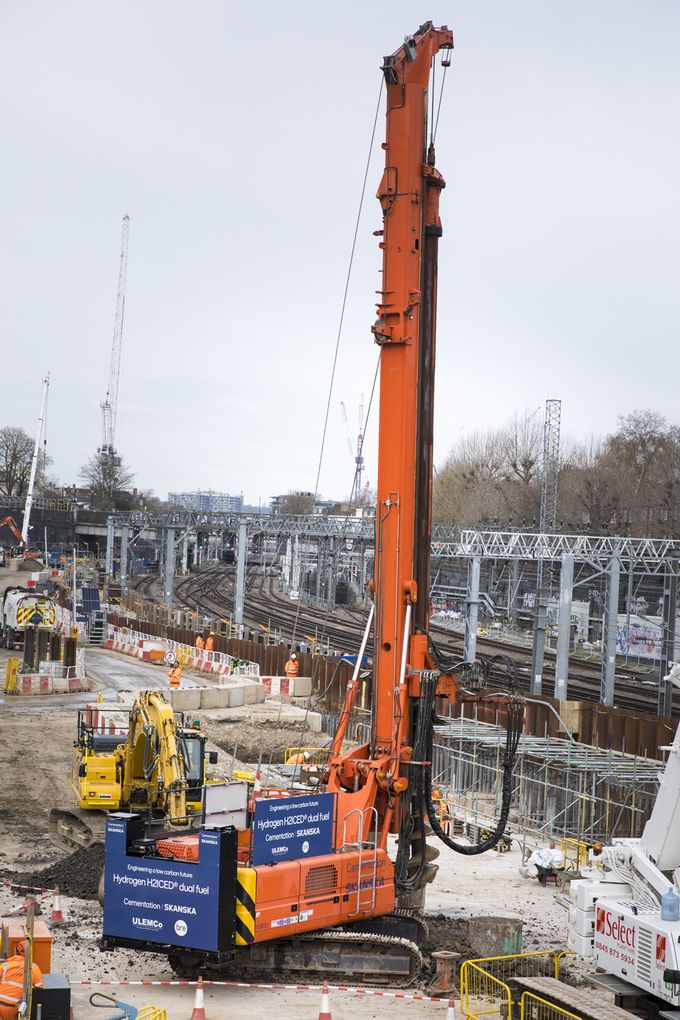
Dual-fuel piling rig being trialled on London HS2 site. Image credit: HS2 Ltd
Concrete gains
The event also heard from Matthew Gregory, senior project manager at Cementation Skanska. He cited cases where his firm had achieved significant carbon savings over the past five years by adopting non-traditional construction materials and vehicle fuels.
On one project, Skanska’s use of lower-carbon concrete mixes provided a 45% reduction on baseline CO2 emissions with no loss of structural strength. In 2021, the company introduced hydrogenated vegetable oil to fuel its fleet of machinery. Since then, it has used drilling rigs with fuel mixes comprising 13% hydrogen, along with a fully electric piling rig that can deliver the same power as a diesel-powered equivalent.
“We’re proving that we can do it,” Gregory said of Skanska’s adoption of electric plant. “There are challenges to get it out there regularly to every project – you need a very long mains cable to start with – but you can do it, with planning.”
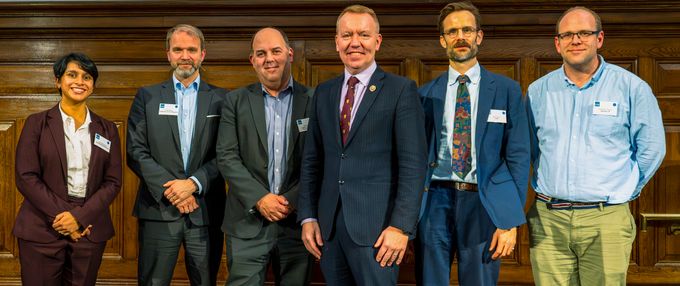
Digging for net zero speakers (from left): Dr Asha Panchal, Professor Lewis Barlow, Dr Keith Bowers, ICE President David Porter, Dr Neil Phillips, Matthew Gregory
Sign up to receive news from ICE Knowledge direct to your inbox.