The Lower Thames Crossing has been designed to be "the greenest road ever built in the UK", says National Highways
The road to net zero
In September 2025, ICE South East England hosted a Carbon Competency Roadshow event focusing on the LTC as a case study in how to deliver low-carbon infrastructure on a large scale.
One of the guest speakers was Lucy Hayes, National Highways’ head of carbon management on the project.
“We saw that things needed to change in the construction industry,” she said, explaining that the LTC represents an opportunity to set a new decarbonisation benchmark for the sector.
Hayes outlined the three core “carbon ambitions” of the delivery plan:
- Construct with the lowest practicable emissions.
- Test innovative low-carbon methods and technologies.
- Leave a legacy that enables future projects to achieve carbon-neutral construction.
“Integrating carbon considerations into leadership discussions must be central,” she said. “Our approach to leadership aligns with PAS 2080 principles of integrating carbon management into every aspect of the decision-making process.”
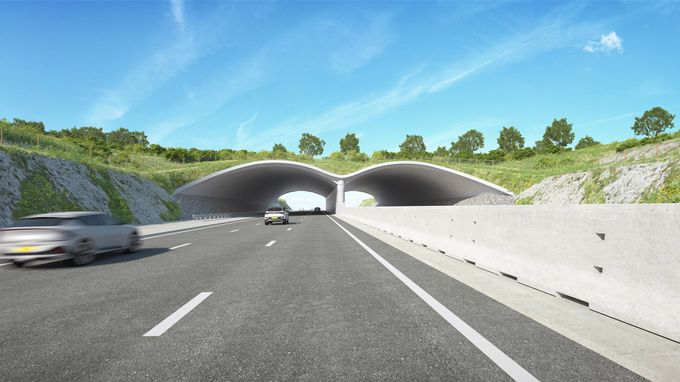
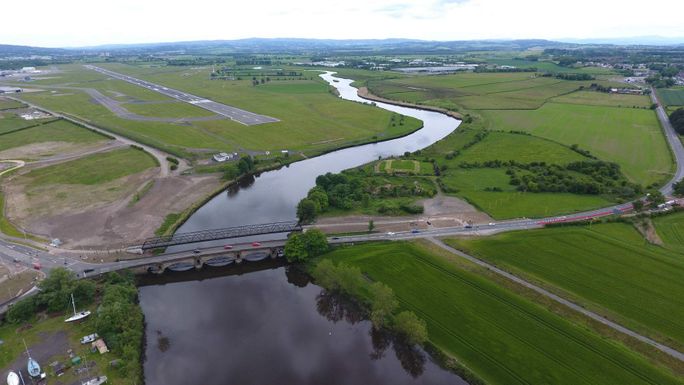
This pre-fabricated bridge, built offsite, is one example of how the project is using lower-carbon construction methods
Low-carbon procurement
Hayes stressed the importance of establishing clear, measurable objectives designed to minimise the LTC’s whole-life carbon impact.
National Highways is using data from 2020 to establish a baseline against which it will cut CO2 emissions across all of its projects. As well as providing “an equal starting point for everyone”, this standardised approach should enable meaningful comparisons of how various projects are performing against their targets.
The LTC will be the first major infrastructure project in the UK to procure with a binding commitment to low-carbon construction. It’s aiming to achieve its stretch target of a 70% reduction on baseline emissions.
Hayes set out some of the key measures that National Highways took at the procurement stage:
- Using decarbonisation as a differentiator. The procurement process gave carbon reduction a high weighting, making it the joint most important selection criterion.
- Choosing well-aligned partners. Preference was given to contractors and other delivery partners that had already committed to their own net zero goals.
- Setting emission limits based on best practice. National Highways shared its own carbon management model with contractors, asking them to add what targets they felt comfortable with. Their inputs were integrated into the overall tender response.
- Focusing on outcomes, not processes. Contractors were given the flexibility to propose their own carbon management methods.
- Making carbon emission limits legally binding. At the end of the tender process, emission limits were embedded in both contracts and the development consent order application.
Making concrete progress with the aid of BSI Flex 350
The use of lower-carbon construction materials will play a crucial role in achieving the LTC’s decarbonisation objectives.
Mark Culbert, technical lead for materials at Murphy Group – one of the main contractors – also spoke at the Carbon Competency Roadshow event. He outlined how the project’s engineering team had been conducting a large-scale laboratory trial of Earth Friendly Concrete, aligning with guidance provided by the BSI Flex 350 code of practice.
Earth Friendly Concrete, developed by Australian company Wagners more than two decades ago, has won several awards for innovation and sustainability. Its binder system contains no Portland cement, the production of which has an extremely large carbon impact. Instead, it relies on a process called alkali activation, which uses two supplementary cementitious materials – ground granulated blast-furnace slag and pulverised fuel ash – with the potential to reduce CO2 emissions by up to 70%. This alkali-activated binder system is not currently included in the BS 8500-1:2023 UK concrete specification standard.
Working with engineering consultants Arup and Mott MacDonald, the team agreed on a series of performance tests to gauge the feasibility of using Earth Friendly Concrete (supplied by Tarmac under the CEVO brand) as an alternative to traditional concrete in the construction of diaphragm walls.
This initial trial proved successful, prompting the LTC to incorporate BSI Flex 350 into its concrete specification, potentially making it the first large-scale infrastructure project in the UK to do so.
The code of practice’s inclusion at this stage should enable the LTC to assess and adopt future alternative binder systems more efficiently. This should in turn facilitate further reductions in carbon emissions as the project continues.
Early decarbonisation wins
Even before the main construction phase, which is expected to start in 2026, the LTC has achieved significant projected carbon savings on its original plan.
Design specifications have been adjusted to incorporate lower-carbon steel as well as concrete, for instance, while survey works in Kent have pioneered the use of a hydrogen-powered digger. The project has committed to eliminating diesel-powered vehicles from its sites by 2027.
National Highways is aiming to achieve more savings by offering financial incentives to partners that exceed their contractual decarbonisation targets and by making further investments in low-carbon innovations.
By promoting the Construction Leadership Council’s Five Client Carbon Commitments, adopting PAS 2080 principles and striving for continuous improvement, the LTC is aiming to be “much better than typical”, Hayes said.
- Amanda Rice is climate programme specialist at the ICE.
- Image credits: National Highways; Joas Souza; Fereday Pollard
Sign up to receive news from ICE Knowledge direct to your inbox.