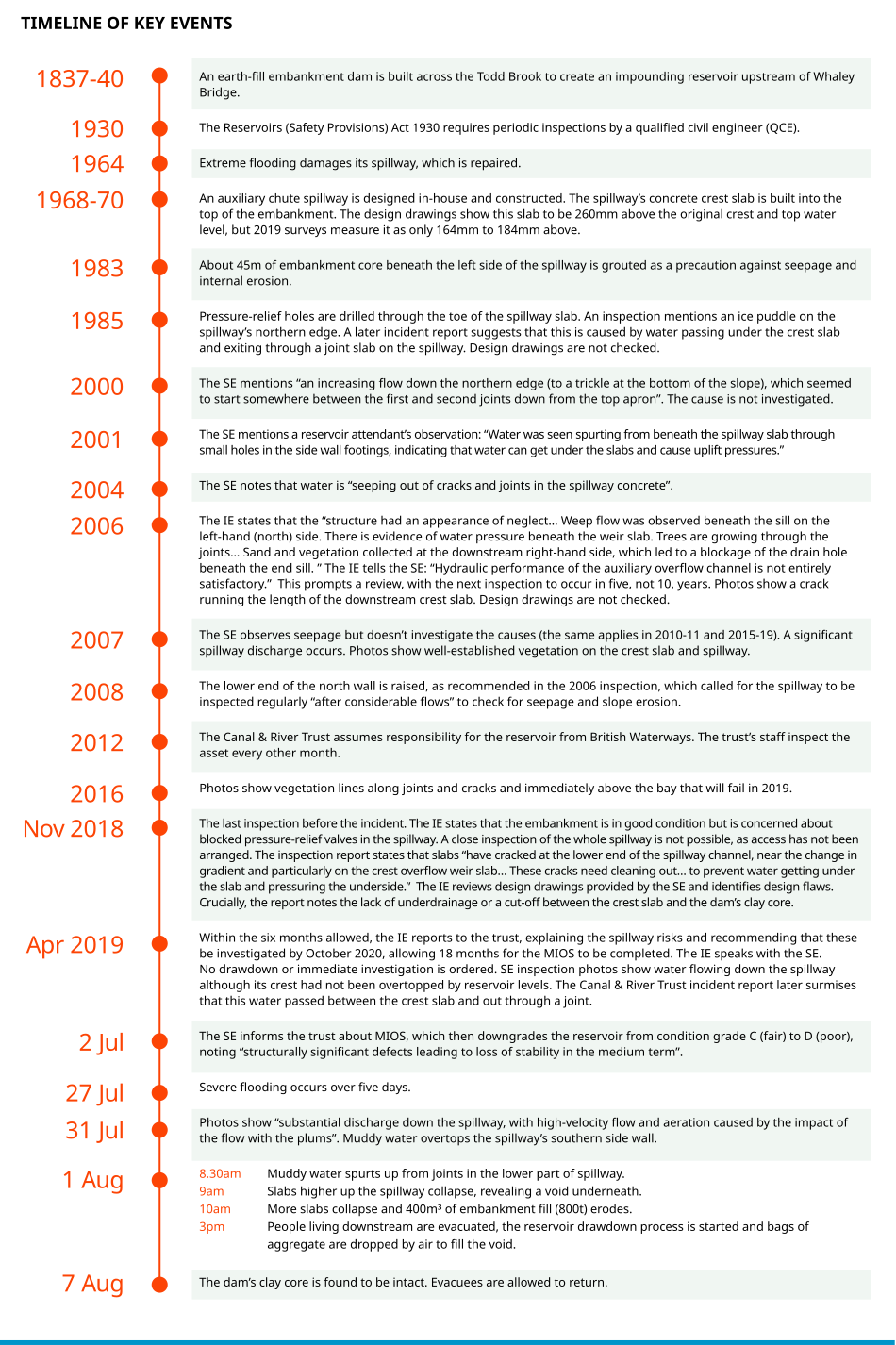

Infographic
Story of the collapse
Design: Paul Weston

Analysis
Incident details
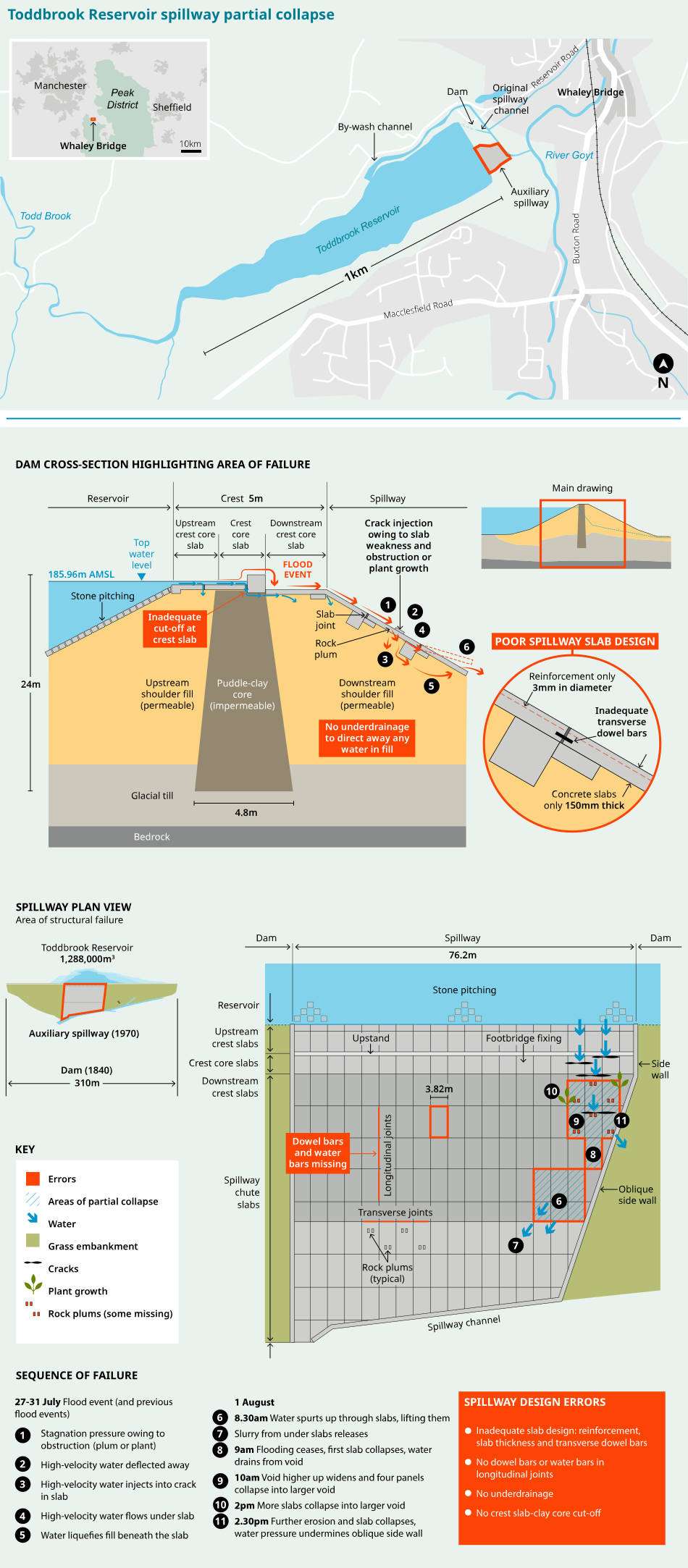
With a capacity of 1,288,000m3, Toddbrook Reservoir was built by constructing an earth-fill embankment dam with a central puddle-clay core across the Todd Brook near the town of Whaley Bridge, Derbyshire. When completed in 1840, the dam was the UK’s highest, at 24m.
Owing to the reservoir’s size and proximity to settlements downstream, it falls into category A, the highest-risk class under UK guidance, for which “a breach could endanger lives in a community”.
In 1964, its primary spillway was damaged after heavy rainfall, so in 1970 an auxiliary spillway was built to increase overflow capacity.
Inspections by the review panel appointed after the auxiliary spillway’s failure confirmed that it had been poorly designed.
They identified the following deficiencies:
- The concrete slabs forming the spillway chute were too thin.
- The slabs did not have sufficient reinforcement, either structurally or for surface crack control.
- The steel dowel bars connecting adjacent slabs in their transverse joints were inadequate.
- There were no dowel bars or water bars (flexible impermeable membranes) in the slabs’ longitudinal joints.
- The spillway had no underdrainage system.
- There was no cut-off between the concrete spillway crest and the dam’s puddle-clay core.
- The spillway had an oblique sidewall and the slabs contained embedded rocks known as plums. Both features disrupted flow during flood events.
- There was no design check on record and no as-built drawing was produced.
Under the Reservoirs Act 1975, high-risk large raised reservoirs in England and Wales such as Toddbrook must be inspected at least every 10 years by a qualified civil engineer known as the inspecting engineer (IE). The IE prepares an inspection report for the reservoir undertaker – usually the owner and the party responsible for the reservoir’s safe operation. The report may specify measures in the interests of safety (MIOS), which must be completed and certified by a set date.
A supervising engineer (SE) is also needed for high-risk large raised reservoirs in England and Wales. This is an ongoing role that requires the incumbent to assess the reservoir’s condition, including a site visit and a review of any instrumentation data, at least once a year. The SE reports annually to the undertaker and the relevant regulator: the Environment Agency in England or Natural Resources Wales. The SE can require the undertaker to appoint an IE to inspect a reservoir before their next scheduled visit if there is reason to believe that it presents safety concerns.
In addition to this statutory regime, Toddbrook Reservoir’s undertaker made frequent site inspections using staff trained in dam safety, including after extreme weather events.
Maintenance neglected
Several IE and SE reports since 2000 raised concerns about cracks and seepage in the spillway crest and chute slabs without fully investigating the causes. They also highlighted plant growth in slab joints and cracks, indicating poor maintenance at times.
The poor state of the spillway identified during the 2006 inspection – which noted that “trees are growing through joints” – prompted its northern sidewall to be raised. But the slabs’ design inadequacies were not identified.
A similar state of disrepair was recorded in 2016. Plant growth was noted along joints and cracks immediately above the bay that would later collapse.
Several inspecting engineer and supervising engineer reports since 2000 raised concerns about cracks and seepage in the spillway crest and chute slabs without fully investigating the causes
During the November 2018 inspection, a close examination of the chute could not be made. The IE reviewed the original drawings and identified shortcomings in the spillway’s design. Concerned by the absence of underdrainage and a cut-off beneath the crest slab, the IE issued MIOS requiring an investigation into the risk of seepage and build-up of water pressure beneath the crest and slabs. Improvements to monitoring for leaks and signs of dam instability were also recommended.
The IE discussed these recommendations with the SE, but did not submit a report until April 2019. They set a deadline of October 2020 for the investigation to be completed.
The undertaker acknowledged the asset’s deterioration and the MIOS, but had not completed the investigation by the time of the spillway failure. Photographs taken in April 2019 show water flowing down the chute even though the crest was not being overtopped.
The day of the incident
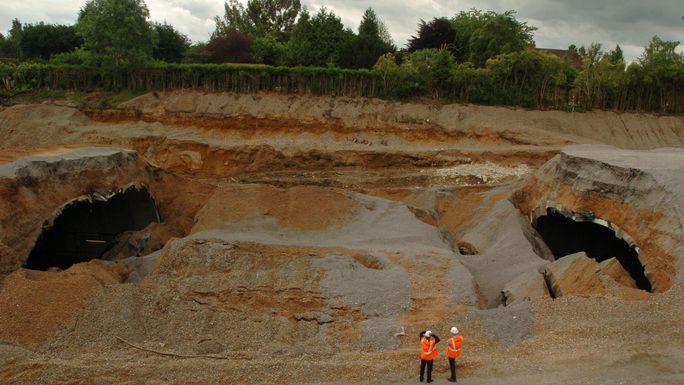
On 1 August 2019, after heavy rain, several spillway slabs collapsed and about 400m3 (800t) of embankment fill eroded.
Initially, slabs towards the bottom of the spillway lifted. Slabs higher up then collapsed into a void.
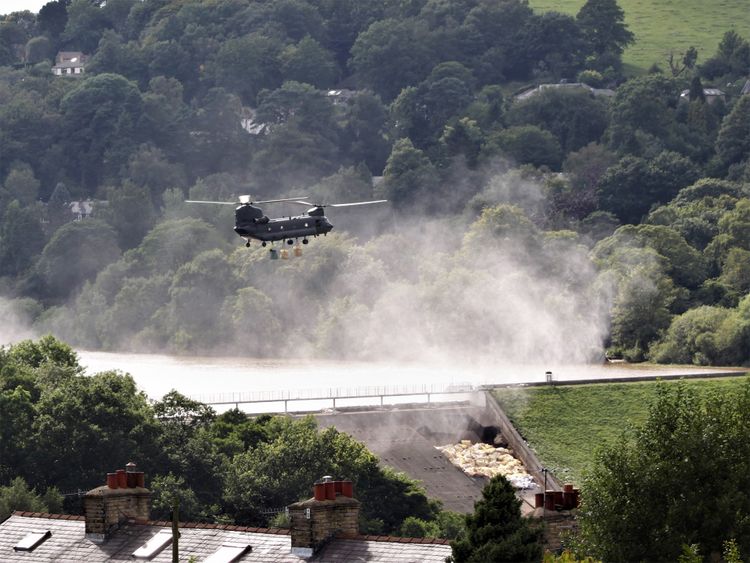
Water seeped beneath the northern wall, which had inadequate foundations, undermining the adjacent grass verge. There were concerns that the dam’s clay core could become exposed, leading to a breach, so 600 bags of aggregate, each weighing 1t, were placed into the void and grouted while 1,500 people living downstream were evacuated. The reservoir was drawn down and further temporary repairs were made.
Investigations and reports
Two separate post-incident investigations resulted in reports dated February 2020. One was led by past ICE president Professor David Balmforth for the Department for Environment, Food & Rural Affairs. The other was conducted by an all reservoirs panel engineer for the undertaker, the Canal & River Trust.
Both reports agreed that poor design had led to the spillway collapse. But they differed in the emphasis placed on the design elements they considered defective and the extent to which poor maintenance had contributed to the incident.
Balmforth concluded that intermittent maintenance had enabled cracks to develop in the spillway slabs and disrupt the flow. This had in turn allowed water to be injected through the cracks (and joints between the slabs), which liquefied the underlying embankment fill. That caused slabs lower down the spillway to lift first and create a pathway for fill to be transported away. As a result, a void higher up the spillway formed, into which slabs eventually collapsed. This mechanism is well documented in the US, where a report into “crack injection” was published in 2007.
The Canal & River Trust’s report focused less on crack injection and more on a gap between the spillway crest slab and the top of the dam, through which water could pass “almost from day one” when the reservoir level was high enough (not necessarily overtopping). The gap had been caused by the building of the crest slab as much as 96mm lower than designed, combined with the settlement of the embankment beneath over time.
An inadequate connection detail between the rigid crest slab and the dam’s core (“cut-off”), plus a lack of underdrainage to direct the flow away, enabled water to pass from the reservoir, when it was high enough, along the top of the clay core and into the embankment fill beneath the spillway before emerging through weak spots on the chute’s surface. The lack of regular maintenance (removing plant growth, repairing slab cracks and clearing blockages in pressure-relief holes) had exacerbated this problem.
Concern that reservoir regulations were not effectively aligned to assure safety prompted Balmforth to review them and recommend changes in a further report published in March 2021.
Causes of failure
The chief causes of the failure and the lessons learnt from them can be grouped into the following categories:
Cause 1: inadequate retrofit design and checking.
Cause 2: inadequate supervision and monitoring during construction.
Cause 3: inadequate operational monitoring, inspection and maintenance.
Cause 4: shortcomings in reservoir regulation.

Lesson 1
Inadequate retrofit design and checking
There were several shortcomings in the design of the spillway and the way it was retrofitted to the dam in 1970. The key design mistakes were as follows:
- Inadequate slab design. The slabs on the spillway were not thick enough, at only 100mm to 150mm with a single layer of 3mm diameter reinforcement.
- Inadequate articulation and waterproofing provision between chute slabs. Transverse joint dowel bars were inadequate and there were no dowel bars or water bars in longitudinal joints. This meant that the slabs were less able to tolerate movement and more likely to crack. The lack of water bars allowed water to seep into and out of the embankment under the spillway.
- Obstructing features on the spillway surface. The embedded plums obstructed the flow, which increased water pressure locally during flooding. The plums’ sockets also reduced the thickness of the slabs and thereby created a further vulnerability to cracking. In addition, the spillway’s oblique northern sidewall encouraged reflective waves to develop during flood events, the hydrodynamic effects of which had not been considered in the design.
The key shortcomings in how the spillway was retrofitted to the dam were as follows:
- Inadequate seepage cut-off to the top of the dam’s clay core. This allowed water to travel from the reservoir, when levels were sufficiently high, beneath the concrete and into the downstream fill, promoting erosion.
- Lack of underdrainage to control seepage flows without eroding embankment fill. With no underdrainage, water pressure increased under the slabs, forcing water up through the joints between them and through the cracks that had formed in them.
- The settlement of the earth-fill embankment was not considered. Since the crest slab remained rigid and the embankment fill beneath it settled over time, a gap opened, creating paths for seepage.
Lessons on design and checking
In June 2022 the Environment Agency published a detailed design guide for spillways of various types. This sets out what has become nationally recognised as best practice. The following points, derived from the guide, apply to smooth concrete spillways such as the one at Toddbrook Reservoir.
TRAINING 1. Spillway structures should have slabs of sufficient thickness, tightness and strength to prevent surface cracking.
TRAINING 2. Joints should have adequate slab-to-slab dowel bars and waterproof connections for articulation and to prevent seepage, plant growth and the cracking and lifting of slabs.
TRAINING 3. Features such as plums should not be included, as they can create zones of water pressure high enough to weaken slabs and induce cracks. (Established plant growth has the same effect.)
TRAINING 4. An oblique wall cutting across the path of flow should be avoided because it creates additional forces from turbulence and cross waves. Where such a wall is unavoidable, the overall impact of its geometry on the wider factors affecting a spillway must be considered.
TRAINING 5. Allowance must be made for embankment settlement and movement in the overall design of the spillway and slab detailing, particularly on retrofit projects.
TRAINING 6. Adequate cut-off into the top of the main embankment’s clay core is required to prevent reservoir water seepage above the core from creating an erosion flow path (in the absence of underdrainage) through the downstream fill.
TRAINING 7. Underdrainage enables seepage flow to be directed away, preventing a build-up of water pressure from potentially eroding embankment fill.
Lesson 2
Inadequate supervision and monitoring during construction
There is no evidence of any independent checks of the spillway design, so mistakes in the original slab drawing were never identified for rectification.
Furthermore, no as-built drawings were made to check the construction against the design. The process of producing such drawings would have highlighted the lack of longitudinal dowel bars and water bars, enabling those flaws to be remedied.
Similarly, the lower as-built height of the crest slab would have been recorded and action taken to address the discrepancy. This could have been done either by making the consequences known – i.e. that the crest would be overtopped more often (during lesser flood events) than the design had assumed – or by building up the slab.
Lessons on supervision and monitoring
TRAINING. It’s important to check as-built construction against the design intent and produce as-built drawings.
PROCESS/PRACTICE 1. Independent checks are required to pick up and address design mistakes at the outset.
PROCESS/PRACTICE 2. As-built drawings are needed to confirm that the design intent has been fulfilled and to identify any deviations from it to inform future maintenance work.
Lesson 3
Inadequate operational monitoring, inspection and maintenance
Those responsible for inspection and maintenance at Toddbrook Reservoir showed a lack of appreciation of the warning signs of failure.
While the qualified civil engineers in this case may have believed that they were working in accordance with the reservoir regulations, they took insufficient action to ensure the safety of the asset.
Lack of monitoring of the spillway’s operation owing to non-functioning or absent instrumentation meant that changes in pore pressures or survey levels were unknown. Monitoring from piezometers and other equipment in the embankment may have alerted engineers to changes and enabled them to determine whether these had resulted from normal ageing or abnormalities.
Inadequate inspections over the years meant that warning signs were missed. In the last inspection before the incident, the IE was unable to obtain a close-up view of the spillway because the undertaker had not arranged access over the steep central section. The IE did not press for access later.
The report’s recommendations lacked urgency and contained neither clear explanations of the dangers nor clear details of the remedial works required. No immediate instructions were given to safeguard the spillway before further investigations could take place.
Inadequate maintenance allowed structural deterioration. Long periods of plant growth created cracks and seepage routes in the spillway’s slabs, while blocked drainage-relief holes allowed water to build up. Those responsible for maintenance tended to wait for instructions arising from inspections before acting. Concerns that day-to-day maintenance activities were below the expected standard were never addressed.
Lessons on operational monitoring, inspection and maintenance
Alongside the design guide it published in June 2022, the Environment Agency also issued a spillway examination guide for reservoir undertakers, IEs and SEs. This remains the main source of best practice in spillway inspection and maintenance, but some general lessons are listed below.
TRAINING 1. Simply satisfying the inspection and maintenance regulations may not be enough to guarantee the safety of reservoir structures. Instead of a narrow focus on statutory compliance, a risk-based approach covering the full picture of quality and safety is needed.
TRAINING 2. There are various warning signs of failure – e.g. plant growth, cracks and seepage – that must be addressed in a timely manner.
TRAINING 3. Older structures may need different methods or levels of inspection and maintenance. Inspection has traditionally been a manual task, but technology can be used to monitor an asset’s condition effectively via a combination of sensors, satellite images and surveys. Climate change may impose various stresses on an asset, so meteorological data can aid safety management. Toddbrook Reservoir’s dam should have been able to resist the heavy rainfall that triggered its failure.
PROCESS/PRACTICE 1. The importance of thorough inspections and effective maintenance must be championed at all management levels.
PROCESS/PRACTICE 2. Use monitoring data – e.g. from piezometers in the embankment – to identify expected and unexpected spillway behaviour to inform maintenance work. Ensure that monitoring equipment is always in good working order.
PROCESS/PRACTICE 3. The causes of openings, worsening cracks, seepage and plant growth should be determined, communicated to higher management and addressed promptly.
PROCESS/PRACTICE 4. Established vegetation can cause slab joints to open and cracks to form, creating weaknesses. Remove plants; repair joint openings and cracks; and clear blocked drainage holes.
PROCESS/PRACTICE 5. Regular maintenance activities must be performed to the required standards. Any deficiency in this area should be reported to higher management to mandate remedial action. Such works do not need to wait for instructions from inspection reports, which can take a long time to issue.
PROCESS/PRACTICE 6. All historic information about design, construction and maintenance should be made available to the inspector. But past inspection reports alone should not be relied upon as evidence of an asset’s current condition.
PROCESS/PRACTICE 7. Soon after each inspection, the IE should discuss their recommended actions with the SE and the reservoir undertaker, indicating how soon such works should start and recommending any temporary safety measures.
REGULATIONS/STANDARDS. The safety management effort required in the inspection and maintenance of high-risk reservoirs should be proportional to the hazards posed and have specific regard for how these change over time.
CULTURE. To ensure that infrastructure quality and safety issues are properly addressed, people must feel unafraid of disclosing concerns. These should ideally be handled as they arise on a project, but they can be reported to Collaborative Reporting for Safer Structures UK (CROSS-UK). When people feel under intense pressure to deliver, fear that admitting failure could cost their jobs, overly trust others’ judgement or are simply unable to grasp that the worst can happen, they are unlikely to raise their concerns, increasing the likelihood of a serious incident. The ICE’s Code of Professional Conduct offers guidance on how to approach such difficult situations.
Lesson 4
Shortcomings in reservoir regulation
Reservoir regulations are being reviewed with the intention of updating them.
Regulatory compliance failed to ensure safety in this case. Although cracks, seepage and plant growth were documented, inadequate action was taken to understand their causes and make timely repairs. An ingrained cycle of ineffective inspection and poor maintenance was repeated for decades, with little use of new technology to aid monitoring, inspection and decision-making.
Successive undertakers of the reservoir (British Waterways had this role before ceding it to the Canal & River Trust in 2012) may have had a passive approach to safety management, since they relied on recommendations from inspections and the assurance that regulatory compliance provided. Although the IE sought out the original drawings and discovered the slab design faults, it was not routine at the time to have historic records readily available as part of the inspection process. Recent guidance has since made it accepted practice to provide access to such information.
The quality of Toddbrook Reservoir inspection reports contributed to the undertaker’s incomplete grasp of the safety risks, with the IE not clearly conveying their urgency.
Lessons on long-term regulation
TRAINING. Everyone involved in reservoir safety should keep up to date with the latest regulations and guidance. The British Dam Society and the UK’s four national regulators – the Environment Agency, Natural Resources Wales, the Scottish Environment Protection Agency and Northern Ireland’s Department for Infrastructure – are the key sources of information for this. The International Commission on Large Dams and the Association of State Dam Safety Officials offer supplementary resources.
REGULATIONS/STANDARDS 1. The various reservoir regulators should work with undertakers to improve awareness of their responsibilities between inspections.
REGULATIONS/STANDARDS 2. Periodic inspection reports should be systematic and detailed, providing clear, evidence-based recommendations. Urgent MIOS should be stated clearly and completed as soon as practicable.
REGULATIONS/STANDARDS 3. An undertaker should continually manage reservoir safety and, if the risks posed cannot be reduced to tolerable levels, consider the implications of decommissioning the asset.
REGULATIONS/STANDARDS 4. Reservoir regulators should promote good practice by spot-checking inspection activities and reports for quality-assurance and learning purposes. (This has become common practice since the Toddbrook Reservoir incident.)

Timeline
How events unfolded