Building climate resilience with the Strategic Pipeline Alliance
Anglian’s carbon and sustainability manager, Craig Hopkinson, outlined how the organisation has established a 25-year water resources management plan to increase its supply capacity and manage the long-term effects of climate change.
Anglian has invested more than £1bn in its Strategic Pipeline Alliance (SPA) to date. This is its partnership with Costain, Farrans, Jacobs and Mott MacDonald Bentley to build a network of connecting pipelines across not only the East Midlands but also East Anglia, where the company is the main supplier. This will enable it to redistribute water more easily from areas of surplus to those in deficit.
The SPA is delivering a 320km network, running from the Lincolnshire village of Elsham in the north down to Ipswich in the south. This is divided into 12 sections, supported by 10 pumping stations and two storage points. Much of the system and its associated infrastructure is set to be built by 2030.

The Strategic Pipeline Alliance is building a 320km network across the East Midlands and East Anglia
PAS 2080 target-setting across Anglian Water’s assets
Anglian has used the PAS 2080 standard to help it set ambitious decarbonisation goals on the SPA project and across its wider network.
The alliance’s capital carbon footprint was originally projected to exceed 300,000 tonnes – larger than the company’s total capital carbon footprint between 2015 and 2020. Faced with this forecast, Anglian set a target of reducing the capital carbon footprint of permanent works associated with the SPA by 65%. By working with its delivery partners to optimise designs and use lower-carbon materials and techniques, it has since achieved a 67% reduction.
Anglian has also set the separate target of reducing its operational carbon by 27% before 2030. It’s already on track to do significantly better than this.
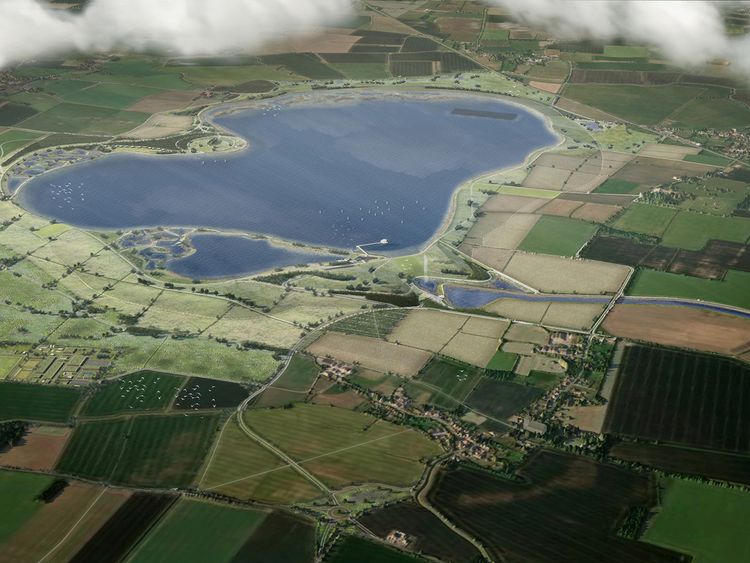
Anglian intends to meet the growing demand for water in eastern England by building two reservoirs: one near Sleaford in Lincolnshire (pictured, top) and the other near Chatteris in the Cambridgeshire Fens. It will incorporate decarbonisation plans into all stages of their development.

A planned new reservoir in the Cambridgeshire Fens is one of two that Anglian Water intends to build to meet increased water demand in eastern England
The importance of collaboration
The roadshow also heard how the Environment Agency has been using PAS 2080 to help integrate carbon management considerations into its decision-making, especially in procurement.
In 2019, the agency initially set the goal of reducing its CO2 emissions by 45% before 2030, in line with the Science-Based Targets Initiative (SBTi). But it reset this after the SBTi revised its guidance in 2022. It’s now targeting a 90% reduction by 2045.
In managing its capital programme for flood and coastal erosion risk management (FCERM), the Environment Agency uses what it calls a collaborative delivery framework.
Its carbon performance lead, Claire Kirk (pictured), explained how the framework helps the agency to work in sync with its delivery partners at all stages of an FCERM project.

It encourages these companies to issue monthly decarbonisation forecasts with accurate data, financially incentivising them to build lower-carbon infrastructure and hit their emission reduction targets.
“We take carbon calculators for projects that are delivered and assess them against the intensity of delivered assets, setting an annual target,” she said.
- Amanda Rice is climate programme specialist at the ICE
- Image credits: Anglian Water, Mathew Power Photography, Joas Souza
Sign up to receive news from ICE Knowledge direct to your inbox.