

The growing need to improve energy security and climate resilience
The whole energy sector has changed radically since the Swansea Bay cancellation. Most crucially, the cost of gas soared when Russia invaded Ukraine in 2022 – and volatility prevails.
While gas-fired power stations account for less than 30% of the UK’s installed electricity generating capacity, the cost of gas still sets the price of electricity. Decoupling the two is widely seen as a must in the effort to reduce the increased cost of living in this country.
The war in Ukraine also exposed the UK’s dependence on international markets that have proved more prone to disruption than most had imagined. This has focused policy-makers’ minds on how to bolster British energy security through greater self-reliance.
The need to improve the climate resilience of coastal settlements has also grown significantly since 2018. Along the Severn and Mersey estuaries – prime locations for tidal range power stations – they are at greater risk from rising sea levels and increasingly severe weather events.
Solutions that offer not only renewable electricity but also flood protection are looking ever more attractive to these vulnerable communities.
The war in Ukraine has focused policy-makers’ minds on how to bolster British energy security through greater self-reliance
The emergence of a more attractive investment model
The high upfront costs of tidal range power plants have always been a barrier to adoption, but a relatively new approach to financing large infrastructure projects could help to surmount this.
At about the time it scrapped the Swansea Bay project, the government approved use of the regulated asset base (RAB) model to fund the Thames Tideway Tunnel, London’s so-called super sewer. Under this approach, a surcharge on consumers’ bills starts repaying investors as soon as construction starts. This substantially reduces investment risk, which means that capital is provided at lower interest rates. With the state underwriting a portion of construction-related risk, the cost of capital becomes lower still.
In 2021, the Boris Johnson government passed a bill paving the way for the RAB model to be used for new atomic power projects. In July 2025, the current government approved RAB to finance the Sizewell C nuclear plant. It’s also being used on the Lower Thames Crossing.
Starting pistol required
The experts speaking at the Autumn Prestige Debate highlighted the above factors as compelling reasons why policy-makers should reconsider the case for building tidal range power stations.
“We need a policy statement in support of tidal range energy – and to be allowed to finance projects using RAB,” said Dr Andrew Garrad, chair of the Western Gateway’s Severn Estuary Commission.
Dr Shaun Benzon, head of tidal project development at Liverpool City Region Combined Authority, agreed.
“We’d like to see a new tidal range energy financing act to enable investment,” he said.

The British Hydropower Association's Kate Gilmartin spoke in favour of tidal range energy at the ICE's recent Autumn Prestige Debate
Kate Gilmartin, chief executive of the British Hydropower Association, noted that the need for a high-level commitment to tidal range electricity generation is becoming urgent, given that the Great Grid Upgrade is gathering pace.
“We require a spatial plan and a policy framework that show where tidal energy fits in the future energy mix,” she said. “It’s important to know where major connections will be, so that the grid is structured to cope with future electricity flows.”
A better way to fund a megaproject?
The regulated asset base (RAB) financing model would seem to offer a win for government, investors and customers alike, said Peter Kydd, strategic adviser at WSP, at the debate.
Under this approach, the government becomes the insurer of last resort, taking on risks that would be too costly for ordinary insurers to cover.
That makes RAB projects more attractive to private investors. No longer needing to hedge against such risks, they lend at lower rates of interest, which reduces the cost of capital.

RAB investors start receiving repayments as soon as the building begins. For costly projects with long construction phases, this substantially reduces interest charges.
Hinkley Point C (pictured) and Sizewell C nuclear power stations have been financed under a contract for difference and the RAB model respectively.
Consumers are expected to pay less for electricity from Sizewell C once it starts operating, but will pay a premium of about £1 a month during its construction phase, which may take 10 years.
Building support at regional level
Western Gateway, a partnership of 28 local authorities in England and Wales, has set up the Severn Estuary Commission to assess the potential of a range of possible sites with fresh eyes.
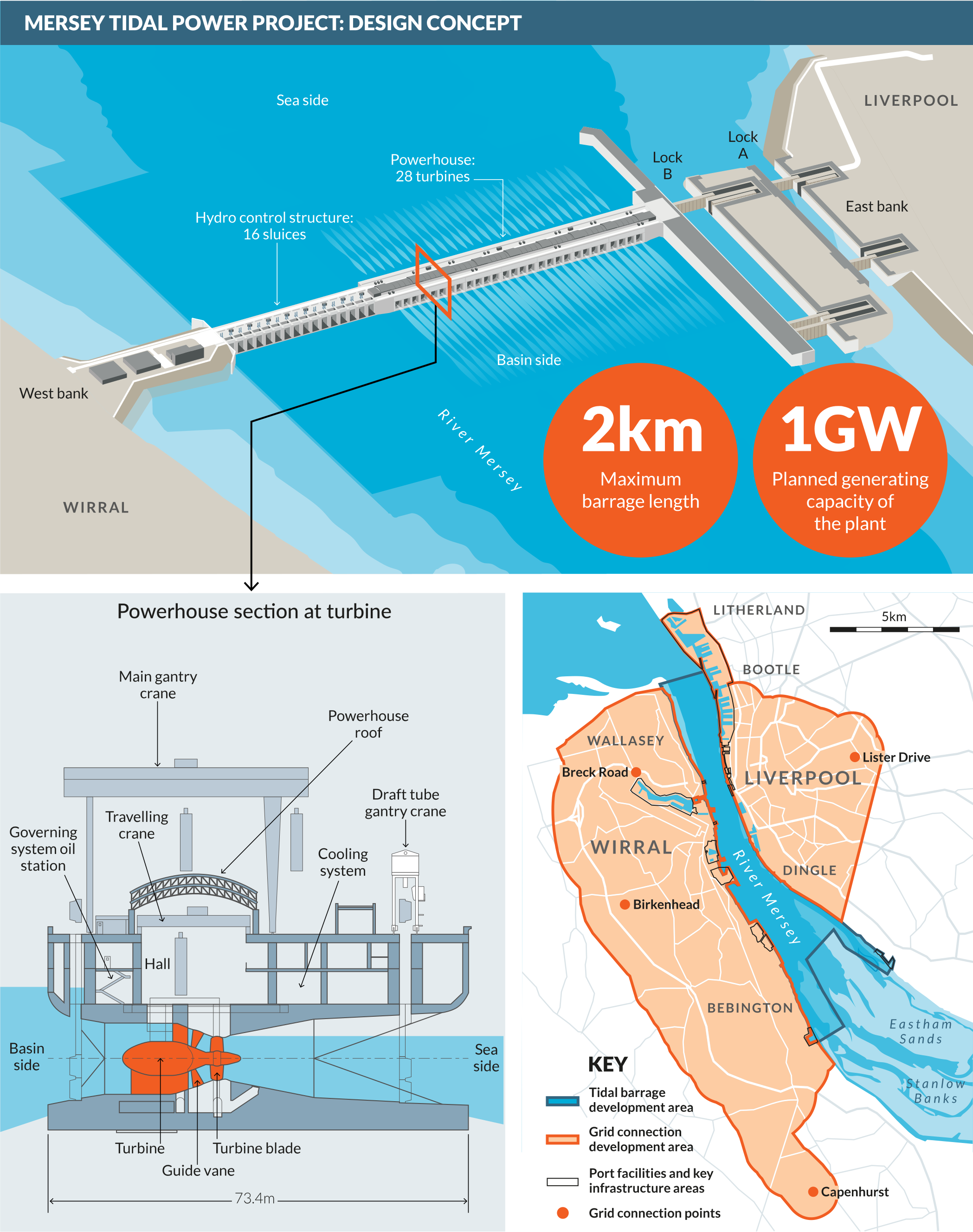
Meanwhile, the devolved Liverpool City Region Combined Authority has used its relative independence from Westminster to form detailed plans for a 1GW capacity barrage-based power station that could start being built in 2028, according to Benzon.

Shaun Benzon (left) discussed proposals for a Merseyside barrage scheme at the debate
“A lot of engagement with stakeholders took place before 2018 and has continued since,” he said. “The right projects, planned the right way, have strong public support.”
Reporting that 80% of Merseysiders back the barrage, Benzon added that his organisation has “managed to address the concerns of port owners and shipping operators. As the offshore wind energy industry develops momentum, ports are seeing new business opportunities and recognise that tidal energy could bring more.”
Tried and tested technology
Benzon acknowledged that there is “a widespread misunderstanding of what tidal range energy actually is. Because we haven’t built a tidal range project in the UK, it gets grouped with experimental technologies. But it’s robust and proven.”
In essence, tidal range power stations use a more durable version of hydroelectric tech that’s been used for well over a century in hundreds of locations around the world. Despite this, there are only two such plants known to be operating on a commercial scale.
The first, the 200MW barrage on the Rance Estuary in Brittany, was built in 1966. In its first two decades of operation, the electricity it produced was the most expensive available in France. But, with its investors long since repaid, its levelised cost of energy has for many years been lower than that of all other options.
The plant has worked constantly since entering service and it’s expected to continue generating cheap renewable energy for another six decades.

Generating electricity since 1966, the barrage on the Rance estuary in Brittany is the world’s oldest tidal power station
The long and short of a tidal power project
A barrage of up to 2km would be needed on the Mersey, depending on the chosen location. A tidal lagoon in the Severn might require a structure running well over 10km.
“That’s long,” Benzon said. “But, when compared with a conventional hydropower dam, tidal barrages are low in height.”
Gigawatt-scale hydroelectric dams typically stand taller than 100m. The Mersey’s maximum tidal range is 10m. In the Severn it’s 14m.
Benzon noted that working in the Mersey Estuary’s “complex environment”, with its busy port, would be testing for engineers.
But he added that the “technical and logistical challenges have all been encountered and solved before” on large maritime projects such as the Fehmarnbelt road tunnel between Denmark and Germany.
Because we haven’t built a tidal range project in the UK, it gets grouped with experimental technologies. But it’s robust and proven
Dr Shaun Benzon, Liverpool City Region Combined Authority
One particular challenge is that there’s a limited supply of skills and equipment in this specialised field.
Also speaking at the event, Dr Paul Ellsmore, project manager at the Offshore Renewable Energy Catapult, asserted that “supply chain constraints drive innovation” – a view shared widely, if cautiously, across the sector.
Benzon expects activity on the Mersey scheme to ramp up as other large international projects including the Fehmarnbelt wind down, freeing up resources and the professionals who know how to apply them. Sand and aggregates will be dredged from coastal sites in north-west England, while most other materials and equipment will be transported by sea.
Benzon sees industrialised construction playing a significant role here. Fabrication units can be “popped up” – as they were for the Thames Tideway Tunnel – and there are several potential sites for these along the estuary.
“There are unknowns, just as there are at the equivalent stage on any project,” he said. “But these are known unknowns.”
Delivering more than just power
Although they are hard to quantify, it’s important to take account of the wider co-benefits that tidal power projects can offer.
Shaun Benzon noted that floods during high spring tides and storm surges are becoming increasingly common along the Mersey Estuary, particularly on the Wirral peninsula west of the river.
“Existing defensive bunds are regularly being overtopped. They need heightening and strengthening at a cost of hundreds of millions of pounds,” he said. “The barrage could be closed when the highest tides are forecast, providing protection to the whole area. Over the coming decades, this would remove the need for a lot of earthworks.”

The barrage (pictured) could also provide a welcome new transport link across the river, potentially dedicated to pedestrians and cyclists.
Benzon called on policy-makers and investors to focus on the target operating life of a tidal range power station: 120 years and possibly more. That’s roughly double the lifespan of an atomic plant, four times that of an offshore wind farm and six times that of a solar array.
Taking other technologies’ replacement costs into consideration, “tidal range generation provides the lowest energy cost per GWh over that timeframe”, he said.
Sign up to receive news from ICE Knowledge direct to your inbox.


