


Guidance document for PAS 4010:2026
Foreword

Andy Alder, chair,
PAS 4010 technical advisory panel
Improving infrastructure productivity is one of the defining challenges of our time. We do not have the money, the carbon budget or the time to continue building in the ways we always have.
We must deliver more of what society and our environment needs, with less, and do it better. Productivity – doing the right things well – is how we achieve that.
This guidance and the publicly available specification it supports, PAS 4010, are a direct response to the challenge. Their origins can be traced back to Improving Infrastructure Productivity – the ICE’s 2022 State of the Nation report – and to the institution’s then President, Ed McCann, whose framing of productivity as effectiveness (doing the right things) plus efficiency (doing things right) formed the theme of his term in office.
That definition sits at the heart of both PAS 4010, which sets out what good productivity management looks like, and this guidance, which shows how to put the specification into practice.
These documents reflect the work of the ICE’s Engineering Excellence Community and the leadership of the Infrastructure Client Group (ICG), expressed through the ICG’s Client Commitments for Productivity Improvement. As with PAS 2080 on carbon management, the greatest advances will come when clients take the lead, setting clear expectations on productivity and creating the conditions in which the whole value chain can perform to its full potential.
Designers and constructors are critical to this, bringing the practical expertise needed to turn productivity ambitions into better outcomes. PAS 4010 and this guidance recognise that improving productivity is an endeavour that can only be achieved as a collaborative team.
On behalf of the technical advisory panel for PAS 4010 and this guidance, I thank the many people who have brought this document to life. They include the members of the panel, who gave their time and expertise so generously; the ICG and the Department for Transport, whose sponsorship and support made the work possible; and the author, for turning a broad ambition into clear, practical guidance.
This is intended to be a living document. Productivity management is a discipline that will continue to develop; our collective understanding of it will only deepen. As organisations apply PAS 4010 and share what they learn from doing so, we will enrich the guidance with that knowledge and new case studies.
I encourage you to use it, test it and help us to make it better.
Contents
2 Understanding productivity in infrastructure
4 Developing a strategy for productivity management (SPM)
- 4.1 The purpose of the SPM
- 4.2 What the SPM contains
- 4.3 Understanding productivity drivers
- 4.4 Developing the productivity plan
- 4.5 Setting targets and baselines
- 4.6 Monitoring and reporting
- 4.7 Embedding learning and continuous improvement
- 4.8 Behaviours that hold the SPM together
- 4.9 A proportionate starting point
5 Productivity through the lifecycle
- 5.1 How productivity moves through the lifecycle
- 5.2 Need and optioneering
- 5.3 Design
- 5.4 Planning and consenting
- 5.5 Delivery
- 5.6 Operation and whole-life learning
- 5.7 A requirement that applies throughout: industrialised construction
- 6.1 Clients
- 6.2 Designers
- 6.3 Contractors
- 6.4 Subcontractors and suppliers
- 6.5 Sponsors and arm’s-length bodies (ALBs)
7 Well-known productivity methods
- 7.1 Lean and production-systems thinking
- 7.2 Design- and manufacturing-led approaches
- 7.3 Evidence, forecasting and benchmarking
- 7.4 Choosing and combining methods
8 Enabling innovation through PAS 4010
- 8.1 Why this matters
- 8.2 Why innovation struggles in traditional delivery
- 8.3 How PAS 4010 creates the conditions for innovation
- 8.4 The kinds of innovation this supports
- 8.5 Putting it to work
- 8.6 Scaling up innovation beyond the programme: i3P and the UK Infrastructure Innovation Accelerator
9 Tailoring and proportionality
- 9.1 Why proportionality matters
- 9.2 Tailoring by project scale
- 9.3 Tailoring for ongoing maintenance and renewal programmes
- 9.4 Tailoring by sector
- 9.5 Tailoring for ALBs
- 9.6 Tailoring by delivery model
- 9.7 The irreducible core
- 10.1 Hypothetical case study: a major rail-corridor upgrade (£600m)
- 10.2 Hypothetical case study: a small clean-water scheme applying a proportionate SPM (£4m)
- 11.1 Transport case study: HS2 Station Road overbridge – reinforced-soil abutments in place of piled reinforced concrete
- 11.2 Transport case study: East Riding Live Labs 2 – removing street lighting from high-speed roads through intuitive visual design
- 11.3 Water case study: Anglian Water’s Strategic Pipeline Alliance – applying the productivity improvement hierarchy across a regional transfer network
12 Demonstrating conformity with PAS 4010
- 12.1 Why a conformity claim is worth making
- 12.2 Three routes to a claim
- 12.3 Scope of the claim – and the evidence behind it
- 12.4 Wording a claim
Section 1
Introduction
Every infrastructure project starts with good intentions. No client sets out to waste money, no designer means to create rework and no contractor plans for workers to stand idle awaiting the late arrival of a drawing. And yet, across the sector, that is too often what happens. Productivity in infrastructure delivery has barely moved in a generation, even as the demands on what we build and the scrutiny of how we build it have intensified. The good news is that none of these problems is inevitable. Most of the lost productivity is the predictable result of information shared too slowly, good ideas raised too quietly and decisions made too late. These are all things we can change.
Publicly Available Specification 4010:2026 (PAS 4010) is the sector’s shared effort to change them. It sets out what good productivity management looks like throughout a project or programme and how each part of the value chain can contribute. This guidance is its companion. Where the specification says what to do, this document is here to help people do it. It explains the thinking behind the requirements, shows what they look like in practice and offers templates and worked examples to help projects and programmes of all shapes and sizes implement them.
It is written for everyone with a stake in UK infrastructure delivery. That includes asset owners and clients, which assume the central role in implementing PAS 4010; and designers, contractors, subcontractors and suppliers, which turn intent into reality.
PAS 4010 is deliberately non-prescriptive, as is this guidance. That is not a way of avoiding commitment. It means that neither the specification nor this document prescribes which tool to use, which variable to track or which contract form to let. Instead, they set out what good looks like, what each part of the supply chain should contribute and how to tell whether it’s working.
Good projects already do much of what the specification asks for. The discipline it adds is about doing these things deliberately, connecting the pieces and making them visible enough to improve. The aim is not to add more process; it’s to obtain better results from the process already in place.
Section 2
Understanding productivity in infrastructure
“Productivity” is a word that means different things to different people. To some, it implies working faster or with fewer hands on the job. But that is a squeeze, not an improvement. PAS 4010 uses the word in a wider sense.
PAS 4010 defines productivity as the extent to which infrastructure delivery converts inputs into outputs and intended outcomes through the combined achievement of two distinct ideas: efficiency and effectiveness (PAS 4010, clause 3.30).
Efficiency is the relationship between the results achieved and the resources used to achieve them – in other words, how well inputs are converted into outputs. In practice, this is about doing things right and minimising waste in terms of materials, effort, energy, land, ecosystems and greenhouse gas emissions.
Effectiveness is the extent to which outputs achieve their intended outcomes. In practice, this is about consistently doing the right thing – selecting the right projects, making the right design decisions and choosing the right delivery models and teams.
The distinction matters because effectiveness can have a much bigger impact than efficiency on a project’s outcome. A focus on building efficiently is not enough; we must also improve at selecting what to build. Real productivity improvement starts further upstream than most efficiency drives could ever reach.
This is why PAS 4010 complements a systems thinking approach. Infrastructure is not a collection of separate assets. It is a set of interconnected networks – transport, water, energy, digital communications – that together form the whole system on which society runs. A decision that looks productive for one project can quietly create costs, delays or waste elsewhere in the system. A drainage solution optimised for one site may push a problem downstream, for instance, or a design choice that saves the designer a week may cost the contractor a month.
Managing productivity well means looking beyond an individual task. It means considering the system surrounding that task and asking not only “are we doing this efficiently?” but also “is this the right thing to be doing at all, given the wider context?”
Closely related is whole-life optimisation. The cheapest asset to build is rarely the cheapest asset to own. A structure that shaves cost in construction but demands constant maintenance, or cannot be adapted as requirements of it change, is a false economy over several decades. PAS 4010 asks practitioners to consider productivity at all stages – design, construction, operation, maintenance and end of life – rather than banking a saving at one point that creates a larger loss at another.
These ideas come together in the productivity improvement hierarchy, which sits at the heart of the specification. This is worth understanding early because it shapes everything that follows. The hierarchy has three tiers, which provide an order of priority for identifying potential productivity gains when considering alternatives to planned activities. The specification describes what each tier tests rather than labelling it (PAS 4010, clause 4.1.1), but in practice the three are commonly described using a shorthand, which this guidance uses throughout. They are:
- Avoid. The most productive activity is one that never needs to happen, so this tier comes first. Before committing to any course of action, ask whether the underlying need can be met another way – e.g. by making better use of an existing asset. The greatest scope to influence whole-life productivity comes when the need for a project is being assessed, while changes made at this point incur the lowest costs.
- Switch. This second tier asks whether a genuinely needed activity can be done in a fundamentally different and more productive way. Is there an alternative design approach, construction material or method that will deliver the same whole-life performance?
- Improve. This tier comes last, not because it is unimportant, but because it has the smallest potential for large productivity gains. Once the scope and approach are fixed, it’s time to optimise: reduce waste, use resources efficiently and apply circular-economy thinking to what is left.
The sequence matters because each tier tests something different: “avoid” tests whether the outcome is genuinely needed; “switch” tests the effectiveness of the available alternatives; and “improve” tests the efficiency of the chosen approach (PAS 4010, clause 4.1.1). Starting at “improve” would skip two tests with the potential for larger gains. Working through the hierarchy in order is one of the simplest and most powerful habits encouraged by PAS 4010.
Illustrative example: applying the productivity improvement hierarchy at the need and optioneering stage and at the design stage
A water company identifies that a rural pumping station’s risk of flooding is increasing as rainfall intensity rises. If it’s flooded, there will be an uncontrolled discharge to a nearby watercourse.
The instinctive response is to build a permanent wall around the station. Working the hierarchy in order, “avoid” is applied first, during need and optioneering: could the risk be eliminated without any new structure? Raising critical equipment on to a plinth within the pumping station’s footprint turns out to remove the risk on its own.
Where the flood risk is more severe and some form of barrier genuinely is needed, “switch” is applied next: is there a fundamentally different way to provide protection? A demountable barrier, deployed only when a flood warning is issued, avoids the permanent land take, visual impact and standing cost of a fixed wall. Restoring floodplain storage upstream may also lower water levels enough to reduce the barrier’s design height.
Only once that choice is settled does “improve” apply during the design stage. Productivity gains can be achieved by standardising on a proprietary modular panel system that’s usable at other sites and integrating it with digital flood-warning triggers to avert unnecessary deployments.
This composite example shows the hierarchy’s greatest productivity improvement opportunities arising well before any structure is designed in detail. “Avoid” tests whether anything needs to be built; “switch” tests what kind of thing; and “improve” optimises only what remains.
Section 3
Overview of PAS 4010
PAS 4010 is a specification, a term with particular meaning in the BSI family of documents. It sets out clear, auditable requirements – the things that shall be done – rather than offering advice. It defines what good productivity management looks like, and what each member of the value chain is expected to contribute, in language precise enough to support assurance. Throughout PAS 4010, “shall” denotes a normative requirement. “Should” is used only within the specification’s notes, which are explanatory rather than mandatory.
At the centre of the specification is a single organising idea: the strategy for productivity management (SPM). The SPM is the framework through which productivity is understood, planned, governed and improved over the life of a project or programme. It asks teams to do three connected things: systematically analyse the factors shaping productivity in their context; form a clear plan to manage the constraints and seize the opportunities they identify; and set sensible targets and then monitor progress towards them.
The SPM is formed collaboratively with the whole value chain, so that the people who understand each constraint have a hand in managing it. But it is owned by the client, which holds the levers (scope, procurement, governance and culture) that make it work.
Crucially, the SPM is not a new layer of bureaucracy. It is a way of organising existing activities and information flows so that productivity becomes a managed discipline rather than a happy accident. For most organisations, adopting PAS 4010 is less about building something new and more about connecting and sharpening what is already there.
At each stage of a project’s life, the specification sets out what is expected of all value-chain members – infrastructure clients, designers, contractors, subcontractors and suppliers – covering leadership and governance; collaborative planning; data collection and measurement; error reduction; and learning. The responsibilities are organised by role so that each reader can find their own part quickly.
And it is non-prescriptive. The specification does not dictate which variables to measure, which contract form to use or which delivery model to adopt. It sets out the principles and the minimum requirements, trusting practitioners to apply them proportionately to the scale, complexity and risk profile of their project. This guidance often highlights the importance of proportionality, because it’s the key to applying PAS 4010 without drowning a small project in processes or under-serving a major programme.
Section 4
Developing a strategy for productivity management (SPM)
4.1 The purpose of the SPM
The SPM is the organising framework through which productivity is understood, planned, governed and improved throughout a project or programme. It translates strategic intent into practical, measurable actions that every member of the value chain can act on.
The SPM does not impose an extra layer of processes. It coherently organises existing activities and information flows to make managing productivity a deliberate discipline. Most of its components will already be happening in some form. The SPM connects them all with a single question: are we delivering the right thing in the right way, with the least waste, throughout the asset’s life?
Although it is developed collaboratively, drawing on the people who understand each constraint at first hand, the SPM is owned by the client, which holds the levers (scope, procurement, governance and culture) that make it work (PAS 4010, clause 4.1.2).
And it is established early, during the need and optioneering stage, before the scope is fixed and design decisions are taken. This order is vital, as an SPM that’s introduced after those choices are made is managing consequences rather than shaping outcomes (PAS 4010, clauses 4.1 and 6.2.2).
The SPM is not a fixed document. It is revisited at each lifecycle stage and decision gate so that it stays relevant as the project develops, with detail added progressively: light at the optioneering stage, when little is fixed, and fuller as scope, design and delivery decisions are made.
4.2 What the SPM contains
PAS 4010 prescribes what an SPM must address, but not its format. In practice, a well-formed strategy will cover six elements:
- A clear statement of productivity objectives, aligned with organisational strategy and whole-life value. This is expressed in terms of effectiveness and efficiency, supported by evidence and reference-class data where it exists (PAS 4010, clause 4.1.2).
- An analysis of productivity drivers. These are the constraints, risks, opportunities, interdependencies and systemic factors that shape productivity. They are identified systematically at every lifecycle stage and shared with the client for inclusion in the strategy (PAS 4010, clause 4.1.1).
- A productivity plan that applies the productivity improvement hierarchy before the scope, design or method is finalised. It sets out the actions to maximise productivity, manage constraints and realise opportunities, assigning clear roles, information requirements and decision points (PAS 4010, clause 4.1).
- Targets and baselines. These are project-specific and programme-level, aligned with standard measures where they exist, with named individuals accountable for setting, monitoring and updating them (PAS 4010, clause 7.1).
- Monitoring and reporting arrangements. Productivity is measured using defined data sources, reporting frequencies, ownership arrangements and dashboards. Mechanisms for early warning and escalation are required so that emerging problems can be addressed promptly (PAS 4010, clause 7.2).
- Learning and continuous improvement. Structured reviews, feedback loops and knowledge-sharing processes help to ensure that lessons are retained and improvements are sustained beyond individual roles and projects (PAS 4010, clause 8).
These six elements are mutually reinforcing. They give strength to the SPM, which must start with a clear statement of productivity objectives from the client.
4.3 Understanding productivity drivers
Understanding what shapes productivity on a project or programme requires analysis. This should be collaborative and grounded in evidence, drawing on the people closest to the work – designers, contractors, subcontractors and suppliers – who can usually pinpoint the areas where value is being lost.
A few questions can help to reveal the main drivers. These include:
- What’s constraining flow, sequencing or access?
- Where are the biggest losses of time, talent, knowledge or materials happening?
- Which design decisions have the most impact on buildability and efficiency?
- What systemic risks – planning, consenting, utilities, interfaces – could undermine delivery?
- Where do opportunities lie for innovation, standardisation or offsite manufacture?
A useful starting point for this analysis is the set of 11 drivers of value for money developed through the Infrastructure Client Group’s productivity workstream (see annexe A1). These capture the factors that most affect cost, productivity and value – from requirements and constraints at the front end, through design, construction and commercial choices, to the cultures and organisational frictions that shape delivery. Working through these in a workshop is a quick way to check that no significant driver has been overlooked.
A role-based approach to finding productivity opportunities, moving from client-level programme decisions down to individual site-operative tasks, can complement this analysis (see annexe A2). It identifies who is typically responsible for key productivity choices at each stage and what a productivity discussion with them might cover.
The depth of this analysis should match the project. A modest scheme may need a single half-day workshop; a major project may warrant a highly structured, cross-discipline diagnostic programme. Either way, the output is a shared view of where productivity is won and lost, which becomes the foundation for the productivity plan.
4.4 Developing the productivity plan
The productivity plan sets out what actions are needed to address each constraint and the opportunities to be realised. Allocating responsibility, it specifies how decisions will be made and how progress will be monitored. Good plans are: client-owned but developed collaboratively; aligned with procurement and contracting; and integrated into existing project controls rather than run as a separate exercise.
Plans will vary according to context, but they typically cover how productivity will be improved by measures such as design optimisation, collaborative planning, readiness reviews, sequencing and interface management, subcontractor engagement and error reduction. The plan is a living document: it is reviewed and updated as the project evolves and its productivity drivers are better understood, not written once and filed.
4.5 Setting targets and baselines
Targets focus effort and make progress visible. PAS 4010 asks members of the value chain to identify the key indicators of productivity for their work and use standard measures wherever possible, so that performance can be compared across projects and over time. They should establish baselines and set targets that are specific, measurable and time-bound (PAS 4010, clause 7.1).
PAS 4010 specifies neither what project teams should measure nor how they should measure it. This is a deliberate choice: the diversity of infrastructure projects means that no single set of metrics would fit all cases. Prescribing one would risk distorting behaviour towards what is measured rather than what matters (PAS 4010, clause 0.6).
The hope is that the industry will use this freedom to experiment with metrics, rather than converging prematurely on a prescribed set. To that end, PAS 4010 requires all members of the value chain to identify the key indicators of productivity for each project and how they intend to use them, applying standardised measures where these exist. But there is also an expectation that novel metrics will be developed and tested. This is why the requirement to establish and properly use data collection and management systems, and to share successes and failures, matters so much. A significant learning phase still lies ahead (see section 5.6).
Common targets could be set against measures such as plan reliability, rework, labour utilisation, production rates, design cycle times and commissioning readiness. Annexe A3 offers some example metrics that could be of use.
Proportionality is important: targets should reflect the project’s scale, complexity and risk profile. A handful of meaningful, well-owned targets will always beat a dashboard of metrics that no one acts on.
Baseline-setting deserves particular care, because a productivity improvement is only as credible as the baseline it is claimed against. Baselines should reflect current good practice and be updated over time as the sector improves, so that today’s good performance becomes tomorrow’s starting point rather than a permanent benchmark. Where data is sparse, especially when setting a baseline for the first time, the honest course is to use the best available comparison; state your assumptions and their limitations plainly; and establish mechanisms to collect better data for next time (PAS 4010, clause 7.1.2).
4.6 Monitoring and reporting
Monitoring is how the SPM earns its keep. It provides a clear view of performance, supports informed decisions and enables timely interventions. Effective monitoring rests on a single source of truth for productivity data; clear ownership of collection and reporting; regular review cycles matched to the pace of the work; dashboards that highlight trends and risks rather than burying them; and mechanisms for identifying emerging problems and alerting decision-makers to them (PAS 4010, clause 7.2).
Integration is what keeps this from becoming a burden. Monitoring should run through existing project controls, using data the project already generates. The aim is not to use reporting for its own sake but to use reporting that reflects reality and prompts action.
4.7 Embedding learning and continuous improvement
Continuous improvement is a central requirement of PAS 4010, not an optional extra (PAS 4010, clause 8). It ensures that lessons are systematically identified, validated and shared, then embedded into later stages and future projects – the step most often skipped in this sector.
Embedding lessons into future projects will usually happen outside the project-specific SPM, but it should still be done by all members of the value chain.
The principle is to treat learning as a core project activity, allocating time to it and making someone responsible for it, rather than squeezing it into the gaps. A lesson that is identified but never re-used has cost effort and returned nothing. Effective methods include structured learning reviews, cross-project knowledge exchanges, design and delivery retrospectives, readiness reviews and thematic investigations into recurring problems.
4.8 Behaviours that hold the SPM together
An SPM is only as good as the behaviours that surround it. Its integrity depends on problems being raised early, constraints being reported truthfully and assumptions being challenged when they threaten productivity (PAS 4010, clauses 4.3 and 8). None of these is a matter of process; all are a matter of culture.
PAS 4010 will be most effective where there’s a culture of psychological safety. This is where anyone can tell the truth about what’s happening on a project without fear. A reporting system that punishes bad news simply teaches people to hide it. An SPM built on concealed problems is worse than none, because it offers false assurance. Creating the conditions for candour is one of the most valuable things an infrastructure client and its leaders can do – a subject returned to in section 6.
4.9 A proportionate starting point
Not every project needs a full SPM on day one. In the early stages or on smaller schemes, a proportionate strategy might comprise a short workshop on productivity drivers, a two- to three-page productivity plan, a handful of key targets, a simple dashboard, a monthly review and a brief lessons-learnt log. That is enough of an SPM to manage productivity without adding red tape – and it can grow as the project does. Tailoring it to scale, sector and delivery model is important enough to warrant a separate discussion in section 9.
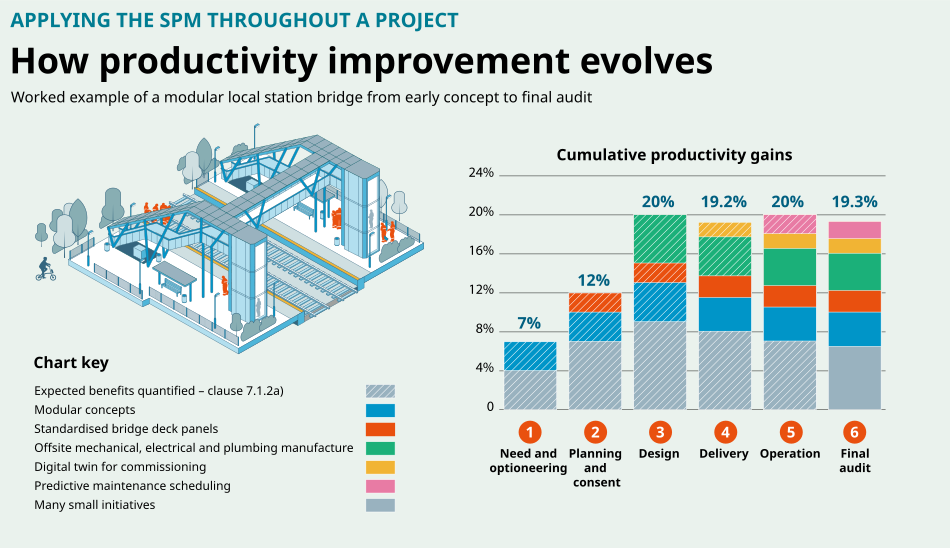
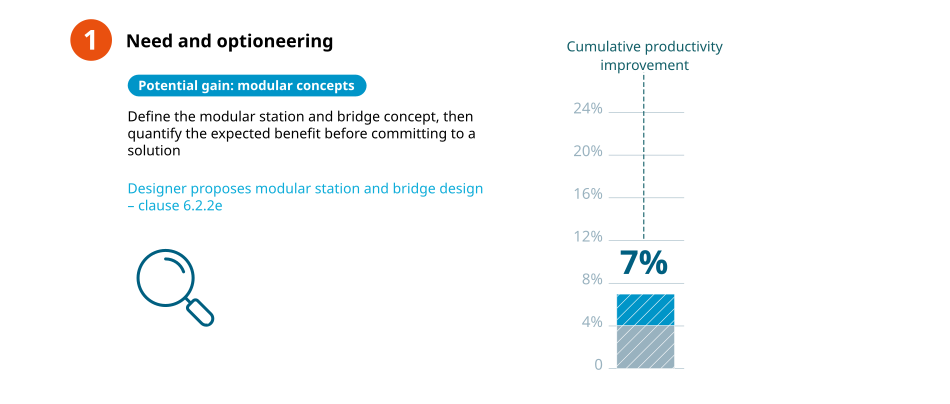
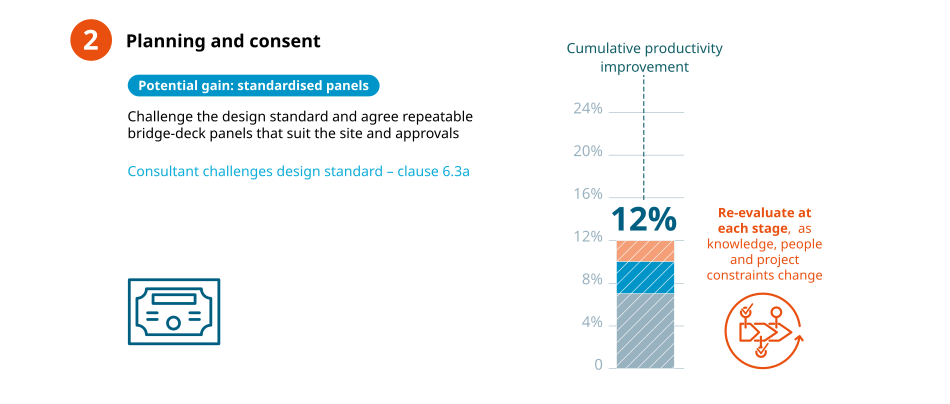
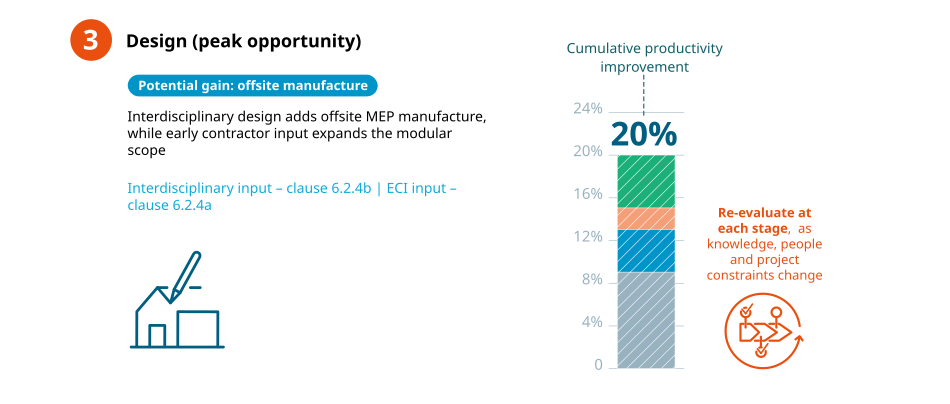
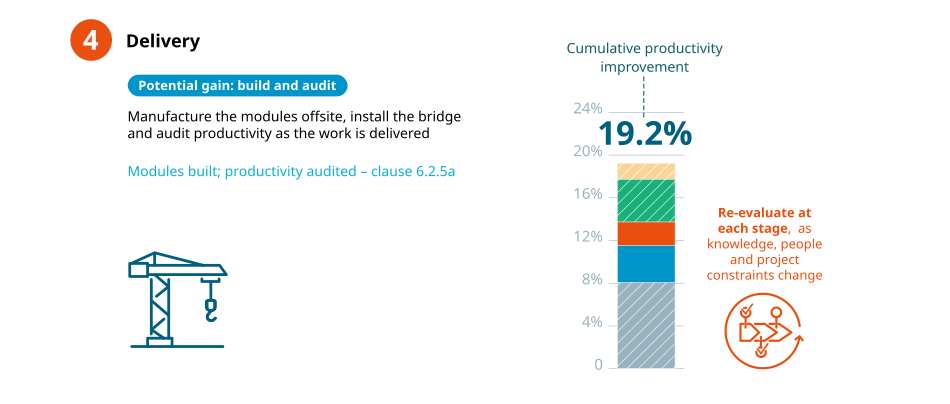
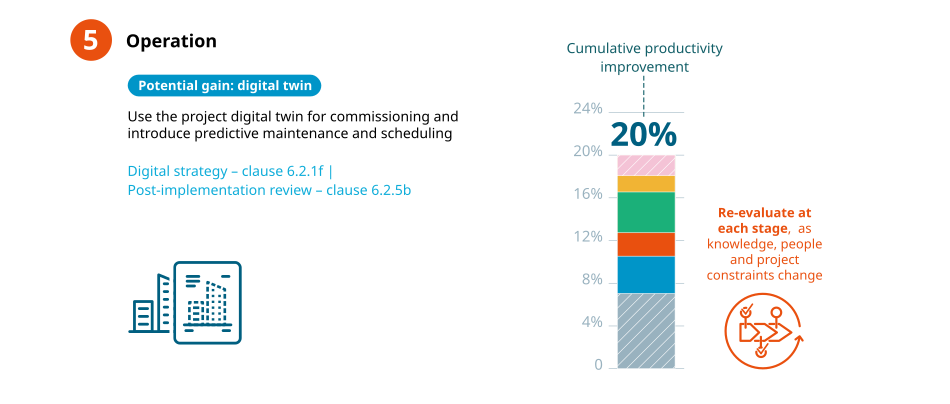
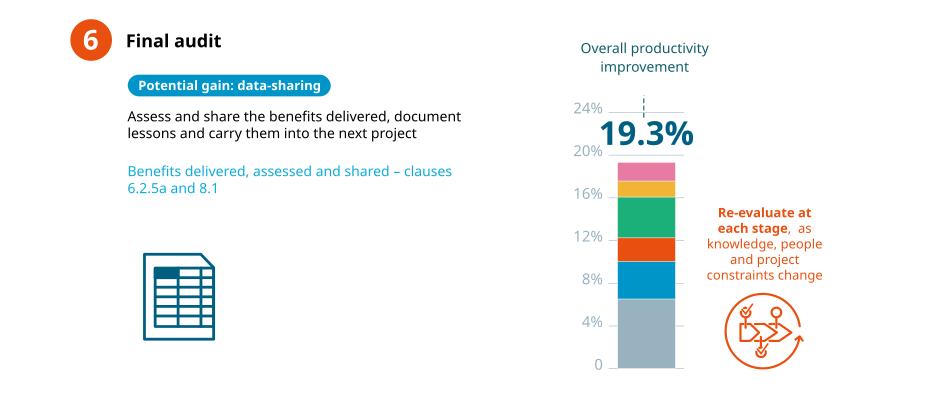
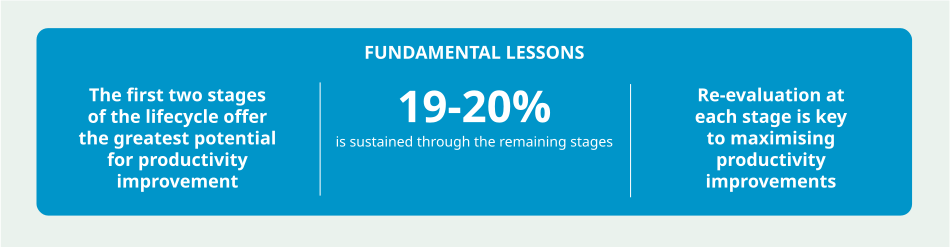
Figure 1: a hypothetical example of how productivity improvement evolves during a project
Section 5
Productivity through the lifecycle
5.1 How productivity moves through the lifecycle
Clause 6 of PAS 4010 sets out how productivity is managed throughout a project or programme, from the first identification of a need through to operation. The principle behind it is simple and follows directly from the productivity improvement hierarchy: the earlier one acts, the more one can change.
At the start, all options are still open and the cost of making a better choice is close to zero. By the time concrete is being poured, the room for manoeuvre – and the prize – has shrunk dramatically. Managing productivity through the lifecycle means acting when there is the greatest scope to influence outcomes, which is almost always sooner than the sector instinctively thinks.
PAS 4010 divides the lifecycle into five broad stages. The boundaries are not rigid – design and consenting in particular tend to iterate rather than run in a strict sequence – but the stages are a useful way to consider where productivity is gained and lost.
| Lifecycle stage | Focus | How productivity is influenced |
|---|---|---|
| Need and optioneering | Define the need, outcomes and constraints | Establish objectives and baselines; test whether the need can be met another way; integrate productivity into the business case |
| Design | Translate intent into a deliverable solution | Design for buildability, flow and efficiency; minimise complexity and over-design; bring construction knowledge in early |
| Planning and consenting | Secure approvals and readiness | Build construction logistics into submissions; avoid consent conditions that quietly throttle productive work |
| Delivery | Execute the works and manage interfaces | Apply the SPM; control flow and reliability; manage supply-chain productivity and rework |
| Operation | Run the asset and record what was learnt | Measure whole-life productivity; feed lessons into future projects |
5.2 Need and optioneering
This stage offers the greatest potential to influence productivity. Before the project’s scope is fixed, the client should define the outcomes in functional terms – what the asset must achieve, not what it must be – and test rigorously whether those outcomes could be achieved by differently scoped alternatives or by adapting existing assets (PAS 4010, clause 6.2.2). Reference-class forecasting and benchmarking belong here too, to set baselines that are realistic rather than optimistic and to record the evidence behind the productivity gains expected of the project.
Part of defining those outcomes is a conscious decision about the design life being sought. The intuitive answer – “build it to last” – is not always the most productive overall. Sometimes, a durable high-spec solution is clearly right; at other times, a cheaper, shorter-lived solution that’s designed to be replaced offers better whole-life value, because replacing it costs less than the upfront expense of building to last. Neither option is inherently more productive. What matters is that the client weighs the options on a whole-life basis and chooses deliberately, with the trade-offs understood and recorded (PAS 4010, clause 4.1.1).
The same discipline applies to innovation. A novel solution, or a lower-cost one, that then fails to reach the design life it was specified to meet is not a productivity gain – the remedial work it triggers will usually cost more than the initial saving. An innovative solution should therefore be assured against the design life sought, not merely against first cost. A deliberately short design life can be the most productive choice. An unplanned one rarely is.
Illustrative example: Anglian Water, Grafham Water Treatment Works (WTW) resilience scheme
This project shows what applying the “avoid” principle at the need and optioneering stage can deliver. Grafham WTW supplies more than 800,000 people. The original plan to safeguard it against a serious outage was to lay a 37km pipeline along a route constrained by river crossings, urban areas and a site of special scientific interest.
During optioneering, Anglian Water found that the same resilience outcome could instead be met by reversing the flow through an existing 36km main, adding pumping stations and a new service reservoir. A flow-reversal trial proved the concept.
This solution cut the scheme’s embodied carbon by 61% and saved more than £30m, roughly halving the cost of the initial proposal while achieving the same outcome. It won Carbon Reduction Project of the Year at the 2017 British Construction Industry Awards.
The lesson is the hierarchy in miniature: the most productive pipeline was the one that never had to be laid.
5.3 Design
Productivity should be built into the design. The aim is to design for flow, not only for function: to minimise complexity and over-design; to favour standardisation and modularity where they fit; and to ensure that design decisions actively support sequencing, access and constructability rather than leaving the contractor to absorb the consequences.
The single most reliable productivity move at this stage is to secure construction and supply-chain expertise early, so that buildability is shaped while the design is still fluid (PAS 4010, clause 6.3). Digital modelling can be used to simulate productivity impacts before decisions are finalised, while a clear register of design interfaces keeps unresolved coordination issues from hardening into downstream constraints.
Illustrative example: PD Ports, Teesport No 2 roll-on/roll-off quay wall replacement scheme
The reference design for replacing a deteriorating quay wall at Teesport was a suspended concrete deck on bored piles, with a grout mattress laid on the slope beneath to resist propeller scour. This would mean working both over and in water, using divers to place the mattress, whose underside would degrade in seawater and be hard to inspect.
Reviewing the design, the delivery team concluded that an anchored combi-wall could instead be built almost entirely from land. That would mean no marine plant, no divers, no over-water working, less excavation and offsite disposal – and far easier maintenance over a life extending well beyond the required 50 years.
The main obstacle was a lack of space: an adjacent warehouse and live services left no room for a conventional anchorage. In a design workshop, the team settled on an unusual restraint: a row of sheet-pile counterfort walls tied into the combi-wall through concrete capping beams. They verified this through first-principles calculations and 3D finite-element modelling to reassure the client’s technical adviser.
The change saved about £750,000 on the £5m scheme, cut berth downtime, reduced maintenance requirements and was decisive in making the wider upgrade viable.
The lesson for the design stage is plain: productivity is won by shaping the design around how it will actually be built. (Leonard, Toms and Yap, Civil Engineering, 1 November 2025.)
5.4 Planning and consenting
Productivity is often lost at consent without anyone noticing, because the people securing planning permission and the people doing the building are rarely the same.
Planning submissions that omit or understate construction logistics such as requirements for materials storage and site access are likely to cause later rework and delays. Equally, stringent consent conditions on factors including working hours, traffic and noise can quietly undermine productivity.
PAS 4010 asks clients to build these realities into submissions, informed by the people who will actually do the work, and to leave enough flexibility for innovation in detailed design and method to survive contact with the conditions imposed (PAS 4010, clause 6.2.3). Engaging regulators early, rather than presenting them with a finished position, is usually more productive.
5.5 Delivery
The productivity gains here come from reliable planning and flow.
Collaborative planning helps every discipline to commit to a schedule that everyone believes in, while readiness reviews ensure that the required information, interfaces, resources and approvals are in place before each major work stage begins.
Real-time production control catches problems before they escalate (PAS 4010, clause 6.4), while standard indicators such as percent plan complete, rework and labour utilisation give a shared view of performance. The data captured is the raw material for both intervention now and better baselines in future.
Illustrative example: High Speed 2, zero-trim piling, Euston approaches
A section of HS2 under construction near its future London terminus required about 1,800 bored concrete piles. Traditionally, each pile would be over-poured and then cropped down after curing to achieve the required level by breaking out up to 3m of hard concrete. This is a slow, noisy activity that sits on the critical path and routinely damages reinforcement.
Rather than accept this as a given, the delivery team – the main contractor, foundation specialist and plant supplier – questioned why the excess had to be poured at all. The team developed the “zero-trim pile”, whereby a vacuum excavator removes the surplus concrete while it’s still curing, leaving nothing to crop.
The idea was proven through phased trials agreed with the designer and client before it was applied to a permanent pile. The benefits were squarely about delivery: an expected programme saving of 36 weeks, over £370,000 in costs avoided, 60,000-plus hazardous working hours removed and more than 800t of CO₂e emissions prevented. Crucially, pile cropping was removed from the Euston blockade, enabling the team to hand the line back to Network Rail early.
The lesson at delivery is that the biggest gains often come from removing an activity, not from accelerating it. (Bailie, Lo, Louw and Piper, Civil Engineering, May 2024.)
5.6 Operation and whole-life learning
Productivity does not stop at handover. An asset’s service life is where whole-life value is realised or lost and where the gap between what was predicted and what was delivered becomes clear.
Capturing productivity data at handover, conducting structured learning reviews and feeding lessons back into future projects is what turns a single good outcome into a repeatable one.
Learning is discussed here alongside operation because an asset’s service life offers the clearest evidence of what worked well and what didn’t, but in truth learning runs across all lifecycle stages. The value comes from identifying lessons continuously and, crucially, re-applying them (PAS 4010, clause 8).
Illustrative example: Tideway, lesson transfer across a tunnelling programme
Tideway, the “super sewer” built to stop sewage overflows into the tidal Thames, shows how deliberate learning throughout a long programme turns experience into measurable productivity.
Its secondary-lining works – nearly 30km of concrete lining across sections that each used a different system – drew on experience gained during the preceding Lee Tunnel project, where the form and operation of the shuttering system had caused lining defects requiring costly invert remedial works. Rather than repeat the problem, the team reworked the shuttering system before construction began, so that defect was designed out. It ran a single cross-contractor design working group for nine years as the mechanism for transferring lessons, which proved far more reliable than any one-off handover.
Delivering the sections in sequence let each build on the last – and the gains compounded: between an early major drive and a later one using the same method, the steady-state cost of a section fell from about £22m to £14m, while average production rose from roughly 97m to 148m a week, helped by further refinements to the shuttering system.
The lesson for the operation stage is that learning applied before the next phase of the programme begins can eliminate whole categories of rework instead of merely reducing them, as long as there’s a durable mechanism for transferring and implementing it.
5.7 A requirement that applies throughout: industrialised construction
One lifecycle requirement applies to all value-chain members at every stage and is therefore worth highlighting. PAS 4010 expects project teams to consider design for manufacture and assembly (DfMA), offsite manufacture and industrialised construction as options and to provide an evidence-based justification wherever these are not adopted, rather than simply defaulting to traditional methods (PAS 4010, clause 6.1).
This mirrors the government’s expectation in its Construction Playbook. The intent is not to mandate modular construction methods – they clearly aren’t always suitable – but to make “we didn’t consider them” an unacceptable answer.
Section 6
Roles and responsibilities
PAS 4010 assigns responsibilities to each member of the value chain in proportion to its influence over productivity (see figure 1, below, which shows which parties are covered by the specification’s requirements).
The logic is that productivity improvement is a shared endeavour: everyone contributes, but in different ways. But one requirement applies to all. Every value-chain member shall identify the productivity constraints, risks and opportunities within its scope and communicate these to the client for inclusion in the SPM at every lifecycle stage (PAS 4010, clause 4.1.1).
This is the mechanism that turns the knowledge held at the edges of a project into something the client can act on. It works only if people are confident that their input will be heard.
PAS 4010 does not mandate any procurement route or form of contract – it is a specification, not a contract. But the commercial conditions a client sets and passes on through the supply chain do much to determine whether the specification and the SPM can be followed in practice. Collaborative, outcome-aligned arrangements enable the behaviours that productivity depends on, whereas adversarial, lowest-price ones tend to discourage them.
The right procurement and contractual approach therefore sits alongside PAS 4010 rather than being prescribed by it.
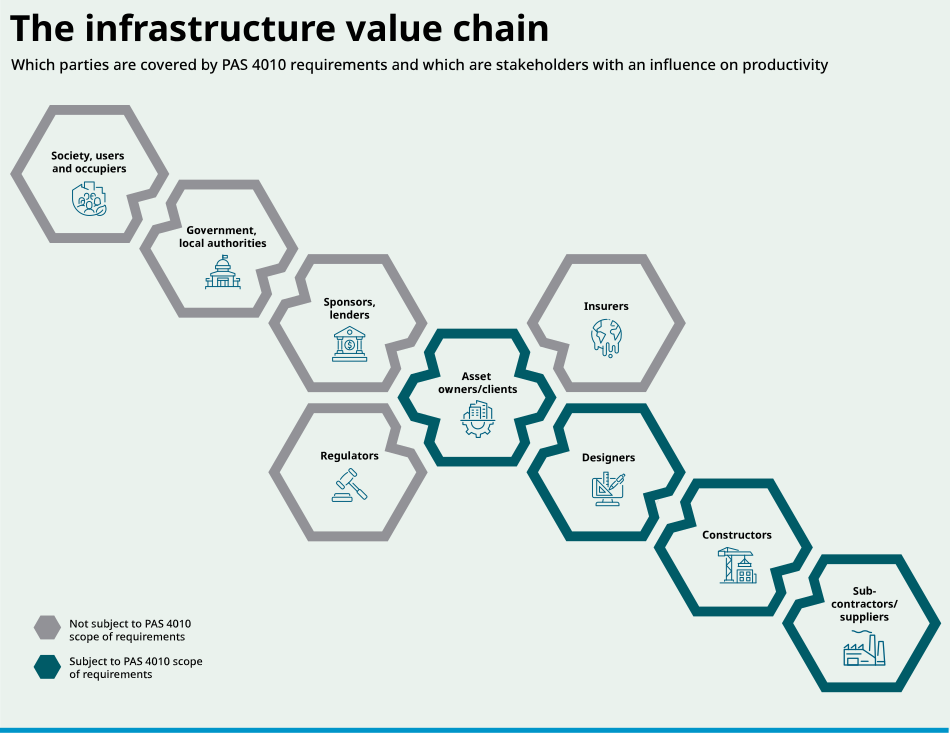
Figure 2: the infrastructure value chain and the productivity role of each member, showing the client at the centre as the owner of the SPM
6.1 Clients
Clients assume the central role in PAS 4010. They commission the work, set the scope, let the contracts, establish the governance and shape the culture. Each of these activities represents a productivity lever.
The client’s core responsibilities are to:
- Own the SPM and ensure that it is developed collaboratively with the value chain (PAS 4010, clause 4.1.2).
- Set clear productivity objectives aligned with organisational strategy and whole-life value (PAS 4010, clause 4.3.2).
- Embed productivity requirements into procurement, including expectations for collaboration, data, planning and reporting. Crucially, this needs to happen before the market is engaged, so that the SPM shapes procurement instead of chasing it (PAS 4010, clause 5.2).
- Establish governance that enables timely decisions, early escalation and transparent performance management (PAS 4010, clause 4.2.2).
- Make information available – baselines, constraints, risks and assumptions – so that others can act on it (PAS 4010, clause 6.2.1).
- Monitor performance against agreed targets and ensure that lessons are identified, shared and applied (PAS 4010, clauses 7.2.2 and 8.2).
- Create the cultural conditions, including psychological safety, that enable teams to raise concerns early, challenge assumptions constructively and innovate (PAS 4010, clause 4.3.2).
The thread running through all these responsibilities is that clients influence behaviour across the value chain more than any other party. When a client treats productivity as a genuine priority – funding it, asking about it, rewarding it in procurement – suppliers respond. When it is present in a client’s documents but absent from its discussions, suppliers notice that too. Effective leadership is not a soft add-on here; productivity depends on it.
Illustrative example: Tideway, client leadership through an alliance model
Tideway, the £4.2bn “super sewer” project beneath the tidal Thames, shows how a client can set the conditions for productivity before any contractor is mobilised.
Delivered under a regulated asset base model offering direct commercial rewards for finishing ahead of schedule, the programme was organised around an explicit challenge from Tideway’s CEO, Sir Andy Mitchell: start onsite six months early; begin tunnelling 12 months early; and commission 18 months early.
He issued this as a mandate rather than a background ambition. It was matched by Tideway’s commercial and behavioural frameworks: an alliance agreement with gain-share/pain-share arrangements covering the main works contractors, programme manager, system integrator and client; the scoring of collaborative behaviour, trust and culture separately from technical and commercial bids at selection; a client-funded innovation scheme tracked as managed data alongside cost and risk; and 54 measurable commitments stated as contractual obligations and reported monthly to the board.
The outcomes included a 17-month reduction in programme duration, more than £125m of confirmed cost savings and CO₂e emissions 28% below forecast. The lesson for clients is that the leadership mandate must be explicit and operational, and that the commercial and behavioural incentives must be aligned before construction starts. At this scale, collaboration cannot be retrofitted to adversarial contracts.
The Infrastructure Client Group’s Client Commitments for Productivity Improvement
Members of the Infrastructure Client Group (ICG) have agreed a set of Client Commitments for Productivity Improvement, to accelerate the adoption of PAS 4010 and demonstrate leadership across the sector. This initiative mirrors the one that boosted uptake of PAS 2080, where a collective commitment by major infrastructure owners created consistent expectations across the market.
ICG members have committed to:
- adopt PAS 4010 and lead visibly on productivity across their portfolios;
- embed productivity capability into procurement, so suppliers are chosen and incentivised on their contribution to productivity outcomes;
- include explicit productivity requirements, including PAS 4010 compliance, in project and programme documentation;
- assess team performance against PAS 4010 as a benchmark for governance, behaviour and delivery discipline; and
- share experience, learning and performance data to support wider adoption and benchmarking.
Each member will report annually on progress, enabling the ICG to publish a collective summary from 2027 onwards – the same annual reporting discipline that underpinned PAS 2080’s success.
Acting collectively, clients can create the conditions for consistent, measurable productivity improvement across UK infrastructure and ensure that PAS 4010 is widely adopted as an industry standard.
6.2 Designers
Designers turn a brief into a buildable, efficient solution. Their decisions influence the productivity of everything downstream. They are responsible for embedding productivity into design – buildability, standardisation, material efficiency – and for identifying and managing design interfaces, so that unresolved coordination issues do not become someone else’s constraint later (PAS 4010, clause 6.3).
PAS 4010 also asks designers in leadership roles to challenge prescriptive specifications, guidance and requirements where doing so could lead to a more productive solution, recording the basis for each challenge (PAS 4010, clause 4.3.3). Much sector waste is locked into old specifications that no one has revisited in years. Designers are often the first to see this and PAS 4010 explicitly invites them to highlight it.
Illustrative example: Tideway, designers challenging the lining specification
The design teams working on the Tideway tunnel’s secondary lining treated the specification they had inherited as a question rather than a given. On the central section contract, re-analysis enabled the thickness of the lining to be cut by 15% with no loss of performance, saving about 15,000m³ of concrete and 7,100t of CO₂e.
A mix using 40% ground granulated blast-furnace slag (GGBS) in place of cement saved another 13,000t of CO₂e. The east section joint venture pushed the same thinking further, reducing the main tunnel’s lining from 300mm to 240mm and the connection tunnel’s lining from 250mm to 180mm, saving 11,000m³ of concrete and 4,500t of CO₂e.
The lesson is that a prescriptive specification, taken on trust, can quietly lock in unnecessary costs that a well-evidenced design challenge would remove.
6.3 Contractors
Contractors lead the planning and execution of the works, converting the design into reality under real-world constraints. They are responsible for developing detailed productivity plans, coordinating subcontractors, managing interfaces and ensuring that data and reporting support good decisions.
Two duties stand out: PAS 4010 asks contractors to plan and deliver enabling works with realistic buffers rather than optimistic sequencing; and to run readiness reviews before major work stages, confirming that the technical, logistical and information prerequisites are in place first (PAS 4010, clause 6.4). The readiness review is one of the highest-return practices in the specification, particularly in a constrained-access environment where a failed start is enormously costly.
Illustrative example: Tideway, readiness reviews and right-first-time delivery
On Tideway, holding a multi-contract tunnelling programme to schedule was treated as something to design in before mobilisation, not to recover afterwards.
Because the programme was working to a P50 schedule, leaving little margin for delays in construction, the teams focused on preventing disruption. Structured readiness reviews were held before the start of each major new activity. Bringing together all relevant parties at senior level, these drew on programme-wide experience and used scenario and stress testing to challenge the method about to be applied. They carried a real mandate to change the approach before work began.
A “step-back” principle applied as standard whenever an unexpected situation arose. This meant stopping, reassessing the risks and agreeing a new plan before continuing. This was backed by staged incident reviews, with a senior review within 24 hours, a root-cause review at seven days and the sharing of lessons across the programme.
The value of this approach became clear when it mattered: at one shaft, a cofferdam deflected 550mm against a 160mm design limit, yet this was resolved collaboratively without a programme-threatening delay, averting an estimated eight months of lost tunnelling time.
The lesson is that, against a tight target, resilience should be built into the method rather than left to contingency. Getting it right first time costs far less than putting it right second time at scale.
6.4 Subcontractors and suppliers
Subcontractors and suppliers bring the specialist knowledge, labour, materials and products on which delivery depends. Their responsibilities are to provide accurate, accessible data on performance and resource use; participate in collaborative planning; and identify opportunities to improve productivity within their scope, which includes giving feedback on construction methods and materials (PAS 4010, clauses 6.5 and 7.2.5).
Where standardisation, offsite manufacture or automation would improve whole-life productivity, subcontractors and suppliers are asked to either support this or provide evidence to show why it is not viable. Early and honest specialist input is the recurring theme, but this will play out only if the contractual and cultural conditions allow it.
6.5 Sponsors and arm’s-length bodies (ALBs)
PAS 4010 does not place requirements on project sponsors. This is a deliberate choice that is worth explaining, since sponsors often have a decisive influence over a project’s productivity – and because the reasoning shapes how this guidance expects them to be engaged in practice.
The specification uses the term “project sponsor” in the specific sense recognised in UK government project delivery, aligning with The Teal Book’s “sponsoring body”: the higher-level authority that provides strategic oversight; endorses a project’s rationale and objectives; and owns the business case stating how the project will meet policy goals. Outside central government, the equivalent role often exists under other names – e.g. investor or promoter – and the reasoning below applies equally to those entities.
PAS 4010’s requirements attach to roles, not organisational labels. In practice, the sponsor is often also the asset owner, particularly in the early stages of a project before a dedicated delivery body or client organisation has been appointed. Where this is the case, the sponsor is already subject to the asset owner/client requirements, not because of what people call it but because of the function it is performing at that point in the project’s life. As delivery progresses and a formal client is appointed, that body then takes on the client's requirements, while the sponsor’s role reverts to the oversight and endorsement function described above.
This is also why PAS 4010 deliberately assigns scope definition to the client rather than the sponsor. The sponsor’s role, both in The Teal Book and in PAS 4010, is to endorse a project’s rationale and objectives but only agree the resulting scope.
That distinction matters for productivity specifically: defining the scope of a project without the discipline PAS 4010 requires of the client (evidence-based option testing, baseline-setting, whole-life cost consideration) is a significant source of productivity losses this specification exists to address. Keeping scope definition within the part of the value chain covered by PAS 4010’s requirements, rather than extending the responsibility to an entity outside it, keeps that discipline intact.
None of this means that sponsors and ALBs are treated as bystanders. Clause 4.1.1 requires all value-chain members to engage relevant stakeholders – sponsors chief among them – from the earliest practicable stage, precisely because their ability to influence whole-life productivity is greatest before the detailed scope is fixed. In practice, this means that the asset owner/client is expected to bring the sponsor into productivity discussions early and keep it informed, even though the sponsor carries no formal obligation under PAS 4010.
Practitioners wanting a fuller picture of the sponsor’s role and responsibilities – including how it interacts with the senior responsible owner and programme or project boards – should refer to chapter 13 of The Teal Book, and, for government sponsors specifically, the Department for Transport’s own code of practice for sponsors.
Section 7
Well-known productivity methods
PAS 4010 is non-prescriptive by design. It sets out what good productivity management requires, but does not mandate any particular method, tool or approach for achieving it. This guidance takes the same stance. The approaches described below are well established in infrastructure and beyond, each with a proven record. None is required by PAS 4010, none is universally right and most work best in combination.
The point is not to adopt a method wholesale, but to pick the parts that address the specific constraints on a project and apply them on the right scale. Using a method because it is fashionable, or because someone on the team likes it, is a reliable way to add cost without adding value. It should be chosen because it attacks a real problem – that is the only good reason.
The approaches fall into a few broad families.
7.1 Lean and production-systems thinking
This is the most influential body of thought on delivery productivity. It rests on a single idea: a project is a production system whose output depends on the smoothness of its whole workflow, not the speed of any one part. Pushing every trade to go as fast as possible tends to create bottlenecks and rework. A steady, predictable flow is more productive, generating fewer defects.
Several established tools sit within this family:
- The Last Planner System and collaborative (“pull”) planning. Developed through the Lean Construction Institute, this is a way of planning in which the people who will do the work base their commitments on what resources, information and access they need, and on what will be available to them when required, rather than being dictated to by a master programme. This method highlights the real prerequisites for each activity weeks before they become constraints. It maps directly on to PAS 4010’s collaborative planning duties (PAS 4010, clause 6.4).
- Takt planning. Borrowed from manufacturing, takt sets a steady “drumbeat” – the pace at which work moves through a sequence of zones to meet the overall deadline – and calibrates each trade to that rhythm rather than to its own maximum speed. It is especially powerful for repetitive and linear works, such as renewals, mains rehabilitation or tower erection.
- Theory of constraints. Developed by Dr Eliyahu Goldratt, this holds that the throughput of any connected system is governed by its single main bottleneck, so improving anything other than that constraint does not help – and may even worsen matters. Its discipline of finding and tackling the crucial bottleneck is a practical way to focus effort. This aligns with PAS 4010’s emphasis on identifying and closely managing productivity constraints (PAS 4010, clause 6.4).
- Supply and flow control. This method focuses on getting the right resources to the right place at the right time. It pulls them to the site when they are needed, rather than pushing them there early, where they tie up cash and space.
- The seven wastes. Using the mnemonic TIMWOOD, this names seven categories of non-value-adding activity – transport, inventory, motion, waiting, overproduction, over-processing and defects – as a checklist for spotting waste. It offers a shared vocabulary for the waste-reduction principle that runs through PAS 4010, without the specification mandating this or any other method.
“Production system design” is the term increasingly used for the discipline that brings these methods together. Its purpose is to determine how work will flow before the detailed programme is produced. Practitioner texts developing these ideas for UK infrastructure include Todd Zabelle’s Built to Fail and Dr Martin Perks’ Productivity by Design, alongside the foundational literature on lean techniques and the theory of constraints.
The connection between all these approaches and PAS 4010 is consistent: they offer practical ways to meet its lifecycle delivery requirements, particularly through collaborative planning, critical-path management and readiness reviews (PAS 4010, clause 6.1).
7.2 Design- and manufacturing-led approaches
A second family of methods addresses productivity at source – in what is designed and how it is made.
Design for manufacture and assembly (DfMA) and offsite construction. These methods move work from constrained, weather-exposed sites into controlled factory conditions, improving quality and accelerating delivery. PAS 4010 asks teams to assess these options and justify non-adoption with evidence rather than defaulting to traditional methods (PAS 4010, clause 6.1), mirroring the government’s expectation in its Construction Playbook.
Value engineering and value management. This is a structured, function-focused way of asking whether the same outcome could be delivered more productively over the whole life – changing the scope, method or material – without losing performance. This is the “switch” tier of the productivity improvement hierarchy in action (PAS 4010, clause 4.1.1). The HS2 reinforced-soil abutment case study in section 11.1 is a clear example of it.
Standardisation and design for repeatability. This is where assets and components are designed so they can be produced and installed repeatedly, enabling learning and efficiency gains over time, rather than treating every element as bespoke.
Illustrative example: design standardisation across a major electricity transmission programme
National Grid’s Accelerated Strategic Transmission Investment portfolio, worth an initial £9bn, is reinforcing the electricity network in England and Wales with the aim of connecting up to 50GW of offshore wind generation by 2030.
Instead of treating each project as a discrete exercise, National Grid identified the design stage as offering it the greatest scope to influence delivery time, since decisions taken there largely dictate what the consenting and procurement teams must work with later. Because they have the greatest bearing on the consenting process, overhead-line structures and the configuration and layout of substations were chosen first for standardisation.
The design work was divided among three delivery partners – WSP, M Group and Laing O’Rourke – according to each one’s capability and capacity. The arrangement is governed by a partnership charter that commits everyone to discuss problems openly as soon as they arise without apportioning blame.
This is a live multi-year programme rather than a completed one, so outcomes have yet to be delivered. The value of this example lies in one key decision: recognising standardisation as a potential lever and choosing where in the design process to apply it, rather than defaulting to bespoke engineering solutions from project to project.
7.3 Evidence, forecasting and benchmarking
A third family of methods is concerned not with how work is done, but with how realistically it is planned and measured.
- Reference-class forecasting. This was developed from the work of Daniel Kahneman, Amos Tversky and Bent Flyvbjerg. It estimates the cost and schedule of a project by comparing it with a relevant set of similar completed projects – its reference class – countering the optimism bias that affects almost all internal estimates. The specification recognises that it can be a useful tool in establishing achievable budgets and schedules and in setting credible baselines (PAS 4010, clauses 5.2.1 and 7.1). Its value depends on the size and comparability of the reference class. Using it when a sufficiently large set of similar projects does not exist can mislead rather than illuminate. It should therefore be applied where the data genuinely supports it.
- Benchmarking and data-driven baselines. This is about using historic and peer performance data to set baselines that reflect good practice, so that claimed productivity gains are measured against a credible starting point rather than an optimistic one (PAS 4010, clause 7.1.2).
7.4 Choosing and combining methods
When choosing a method, the productive starting point is always the constraint: identify what factor is limiting the project’s productivity and choose the approach that best addresses it. Most mature programmes end up combining several – e.g. pull planning to stabilise flow, takt to pace repetitive work and reference-class forecasting to establish credible schedules.
What matters is that these tools are chosen deliberately and applied proportionately. Whichever ones are used, the governance around them must stay anchored to the project’s original purpose. That means continually asking not only “are we doing things right?” but also “are these still the right things to do?” More than any single method, that second question is what keeps a productivity effort honest.
Section 8
Enabling innovation through PAS 4010
8.1 Why this matters
New materials, tools and delivery models can save time on a project and reduce its costs, risks and emissions – sometimes dramatically. But such innovation happens only when organisations have the right governance, information and culture to try new things safely and confidently. Without this foundation, even proven solutions can stall, because no one can see clearly enough, decide quickly enough or carry the risk comfortably enough to say yes.
This is the foundation that PAS 4010 provides. By establishing a structured, evidence-based approach to managing productivity, it removes much of the uncertainty, fragmentation and reactive decision-making that keep good ideas on the shelf. The specification does not prescribe innovation; it does not need to. It creates the conditions in which innovation becomes a normal, managed part of delivery rather than a heroic exception.
8.2 Why innovation struggles in traditional delivery
The barriers are well known to anyone who has tried to introduce something new to a live project. Decision-making is fragmented, so no one feels able to commit. It’s unclear who carries the risk, so the safe answer is no. Requirements shift and design changes arrive late, so there is never a stable base to build on. Information and assurance are inconsistent, so confidence never develops. Commercial incentives reward short-term certainty over long-term value. Constraints and opportunities are hard to spot, while specialists are engaged too late to shape the decisions that matter.
Together, these barriers create a powerful bias towards “the way we have always done it”, even when everyone in the room suspects that a better way exists. PAS 4010 addresses each of these directly.
8.3 How PAS 4010 creates the conditions for innovation
The specification aims to overcome barriers to innovation from several directions:
- By requiring teams to analyse constraints, risks and opportunities at the outset, it creates space for alternatives – be they different materials, modularisation, offsite manufacture or new methods – to be considered before design decisions lock in inefficiency (PAS 4010, clause 4.1.1).
- By mandating collaborative development of the SPM, it brings clients, designers, contractors and suppliers together early, so specialist knowledge shapes solutions while they are still fluid (PAS 4010, clauses 4.1.2 and 4.2).
- By asking clients to define clear processes for assessing and approving more productive or innovative proposals, it removes the single most common reason why good ideas are blocked: that people feel unable to say yes to them (PAS 4010, clauses 4.1.2 and 4.2).
It also promotes innovation in other ways:
- By building innovation into existing assurance processes, it enables novel approaches to be assessed fairly in proportion to the risks they pose, rather than being treated as inherently risky simply because they are new (PAS 4010, clauses 4.2 and 5.2).
- The specification’s emphasis on baselines, targets and monitoring gives teams the evidence to evaluate an innovation objectively, rather than arguing about it on instinct (PAS 4010, clause 7).
- Its learning requirements ensure that an innovation that’s proven once can be shared and applied elsewhere, rather than reinvented each time (PAS 4010, clause 8).
PAS 4010 gives teams the assurance and evidence to adopt more productive solutions with confidence, but confidence that a given solution works is not the same as confidence that it has been introduced responsibly. For that, PAS 440 (Responsible innovation) provides a framework for anticipating and managing the wider risks and impacts of innovative products, processes and technologies before they are adopted. This is particularly useful for early-stage or disruptive innovations, where the productivity case is strong but the broader implications are less well understood. PAS 4010 itself points to it in the note to clause 4.1.1(a): value-chain members identifying and adopting innovative productivity solutions should refer to PAS 440.
8.4 The kinds of innovation this supports
PAS 4010 is agnostic about the form innovation takes; it simply makes adoption more likely. Innovation might involve trying new materials, methods, technologies, delivery models or commercial arrangements. The common thread is that the SPM gives teams a structured, evidenced way to evaluate and adopt these solutions, rather than relying on the conviction of a single champion.
8.5 Putting it to work
Organisations can use PAS 4010 deliberately to support innovation. They can do this by:
- including innovation opportunities explicitly in the analysis of productivity drivers;
- using the SPM to create early engagement windows with suppliers, before constraints harden;
- setting productivity-linked targets that reward new methods rather than penalising the risks of trying them;
- using readiness reviews to test and refine innovative approaches before committing to them;
- applying production-based indicators to measure their impact; and
- identifying, sharing and applying lessons, so that a success in one area becomes the default elsewhere.
This shifts innovation from a gamble to a managed, evidenced process.
8.6 Scaling up innovation beyond the programme: i3P and the UK Infrastructure Innovation Accelerator
PAS 4010 creates the conditions for innovation within a project or programme. But the sector’s harder problem sits one level up. The Infrastructure Industry Innovation Partnership (i3P) argues that the real challenge is to share innovations across programmes, clients and supply chains, so that a new solution proven on one project is not trapped there while teams elsewhere tackle problems it has already solved, unaware of its existence. This is exactly the gap that clause 8 of PAS 4010 highlights when it asks organisations to share proven practice across the wider sector. No single client can close it alone.
I3P is one of the most developed mechanisms for closing the gap. A client-led community coordinated by the Connected Places Catapult, it brings clients, contractors and designers together to align priorities and put shared ideas into practice. Productivity is one of its four high-priority workstreams. Led by HS2, the workstream focuses on scaling up methods that reduce rework, improve certainty and increase output. The partnership offers organisations adopting PAS 4010 a way to share what’s worked for them, draw on what others have already proven and so avoid duplicating effort. This is a practical example of the inter-organisation learning the specification calls for.
Building on that model, the UK Infrastructure Innovation Accelerator (UKIIA) provides a funded route for putting proven solutions to wider use, supported by Innovate UK and the Connected Places Catapult. For both clients and suppliers, it offers targeted financial backing and delivery support to aid the spread of successful innovations. Organisations using PAS 4010 to identify and prove productivity improvements are well placed to bring their solutions to wider attention via the UKIIA. Clients and delivery partners should consider engaging with both i3P and the UKIIA as part of their approach to continuous improvement and sector-wide learning, in line with clause 8 of the specification.
Section 9
Tailoring and proportionality
9.1 Why proportionality matters
Infrastructure projects vary enormously by scale, complexity, risk, delivery model and regulatory setting. PAS 4010 is designed to work across that range. A small water scheme and a major rail-corridor upgrade both need to manage productivity deliberately. They differ in how much structure is proportionate to the task. The aim is never to create bureaucracy. A small project with a handful of targets, a three-page productivity plan and monthly reviews can comply with the specification. A major programme will need considerably more than that. PAS 4010 accommodates both. The guiding principle is simple: as light as possible, but as robust as necessary.
9.2 Tailoring by project scale
Scale is the most obvious axis of proportionality and the clearest way to see how the same requirements expand and contract.
On small projects (worth less than about £10m), a minimum viable SPM is enough. That could be a short productivity-drivers workshop, a two- to three-page productivity plan, a couple of key targets, a simple dashboard, monthly reviews and a brief log of lessons learnt.
On medium-sized projects (roughly £10m to £250m), the SPM develops into a structured analysis of constraints and opportunities; a fuller productivity plan aligned with procurement; weekly monitoring of key performance indicators; readiness reviews at the stages that matter; and formalised learning reviews.
On major projects and programmes (above about £250m), a comprehensive SPM is warranted. This means extensive productivity diagnostics; integrated governance and reporting; programme-level targets and baselines; digital dashboards and data assurance; cross-project learning systems; and active development of supply-chain capability.
These thresholds are indicative. What matters is matching the weight of the SPM to the scale, complexity and risk profile of the work in hand.
9.3 Tailoring for ongoing maintenance and renewal programmes
Much UK infrastructure is delivered not through discrete capital projects but through rolling maintenance and renewal programmes commissioned by clients such as Network Rail, National Highways and the major utility companies. In such cases, productivity management belongs in the core operating model rather than standalone project documents.
The proportionate approach is to establish a single SPM that sets common objectives, indicators, information requirements and learning mechanisms across the programme (PAS 4010, clause 4.1.2), while individual schemes run as repeating production cycles. Each scheme will use the same productivity-driver analysis, planning discipline, targets and monitoring, but with lighter documentation and more frequent reviews.
The real benefit here is cumulative improvement. Data from each cycle refines standards, methods and sequencing, so that productivity keeps increasing across the programme and the same lessons don’t have to be rediscovered by each scheme (PAS 4010, clauses 7.1.2 and 8.2).
9.4 Tailoring by sector
The sector constraint analysis in this subsection draws in part, with thanks, on Dr Martin Perks’ Productivity by Design (Black Pear Advisory).
Different sectors face fundamentally different productivity constraints. An SPM should reflect the realities of the sector it serves while preserving PAS 4010’s core requirements.
In transport, the main constraint is usually limited access to an operational network. On railways, possession windows govern everything. These cannot be extended at will, so each possession is best treated as a complete production unit planned to its full capacity, with as much preparation as possible moved offsite. On roads, limited overnight and lane-rental access windows compress productive time, while underground utility conflicts are the most common source of unforeseen cost. Comprehensive pre-design utility surveys and traffic-management planning from the optioneering stage will therefore have the most influence on productivity.
In water, the main recurring constraints are long regulatory consent timelines, the need to work on live networks and uncertainty about the condition of assets. Ground and asset investigations undertaken before the design is fixed will pay for themselves many times over. Takt-based scheduling suits the inherently linear and repetitive nature of much of the work, while early engagement with regulators can convert consent conditions from a downstream surprise into a design input. The sector’s five-yearly cycle of asset management plans also makes carrying productivity baselines forward from one period to the next essential, so that the sector can keep building on its learning rather than restarting each time.
In much of the energy sector, particularly power transmission, outage windows act like rail possessions. The biggest single constraint is usually the process of obtaining development consent orders. Running consenting, land-rights acquisitions and environmental surveys during the design process rather than after it helps to address this constraint. As the grid expands for net zero, offsite-manufactured substations offer a significant productivity improvement too.
In nuclear, the defining constraints are regulatory. The Office for Nuclear Regulation’s approval process governs design changes, methods and commissioning, with safety-critical components carrying lead times measured in years. Avoiding late design changes is more important here than it is anywhere else, because each significant alteration can trigger a safety-case review. For these reasons, project teams should plan a modular construction strategy from the outset, engage with the regulator formally at every major milestone and actively develop capacity in the supply chain.
The same logic extends to gas, telecoms and other linear systems such as flood defences and district heat networks: identify the dominant constraint, calibrate the project’s tools to it and keep working in accordance with the underlying PAS 4010 requirements. The principles are universal; their application is not.
9.5 Tailoring for ALBs
ALBs typically operate within statutory frameworks, multi-year investment cycles and well-established assurance systems. In an ALB environment, integration is preferable to addition: PAS 4010 can be integrated into existing stage-gate processes, investment decision frameworks and regulatory reporting systems, with the SPM strengthening existing governance and assurance structures (PAS 4010, clause 4.2.1). The key throughout is alignment, not duplication – productivity management embedded in the systems an ALB already uses, not bolted on beside them.
9.6 Tailoring by delivery model
A project’s delivery model will shape how the SPM is implemented. Under a design and build arrangement, the SPM should be integrated into design development and buildability reviews. In an alliance, it should be embedded in joint governance and shared incentives, so that productivity sits naturally within the collaborative commercial model. Under a construction management approach, the emphasis will be on engaging subcontractors in developing the SPM, since they possess much of the relevant knowledge. And in public-private partnerships and long-term concession models, the SPM should align with long-term performance outcomes, so that whole-life productivity is built directly into the commercial structure.
9.7 The irreducible core
Whatever the scale, sector or delivery model, and however the SPM is tailored, five elements must always be present:
- an analysis of productivity drivers;
- a productivity plan;
- targets and baselines;
- monitoring and reporting; and
- learning and improvement.
This is the irreducible core of the specification (PAS 4010, clauses 4.1, 7.1, 7.2 and 8). Everything else flexes with context; these five do not. An SPM that contains them, at whatever level of detail is appropriate, is a genuine application of the specification.
Section 10
Hypothetical case studies
The following hypothetical case studies show how PAS 4010 can be applied from need through to learning. Demonstrating the specification’s proportionate use in different contexts, the first covers a major multi-project programme and the second focuses on a small scheme. They are illustrative and composite – built to show how the pieces fit together – and the productivity figures in them are indicative.
For real case studies, see section 11.
10.1 Hypothetical case study: a major rail-corridor upgrade (£600m)
The context. A £600m programme set out to improve capacity, reliability and journey times on a 60km section of busy main line. It entailed track renewals and realignments; the replacement of signalling and interlocking systems; station upgrades; bridge strengthening; and work on drainage, power and telecoms. Running in a live operational environment during tight access windows, it involved dozens of interdependent projects and several delivery partners on a multi-year framework, all contributing to the same outcome.
The challenge. Productivity was being lost systemically rather than in any one place. Late design changes, access restrictions and inter-discipline clashes combined to keep plan reliability, measured by percent plan complete (PPC), at 48%. There was a high level of rework, particularly at the interfaces between the signalling system and other structures. The preparation of sites for work during possessions was slow; the performance of contractors varied across the programme; and lengthy assurance processes created bottlenecks at crucial moments. The task was to lift productivity across the whole corridor, not project by project.
Applying the SPM. The client established a programme-level SPM as the unifying framework, sitting above proportionate project-level strategies for each scheme (PAS 4010, clause 4.1.2). It began with a cross-programme diagnostic exercise that mapped the production system for the main types of work and identified the systemic constraints: design approvals, access planning, logistics, assurance and utilities. From that came a single set of programme-wide objectives and indicators used by every contractor, embedded into the framework agreements so that productivity was a contractual expectation rather than an aspiration (PAS 4010, clause 5.2). It also introduced a programme governance structure that required monthly productivity reviews chaired by the client’s programme sponsor.
The plan in practice. The productivity plan focused on improving coordination, reliability and readiness. All disciplines planned together, holding weekly reviews to identify emerging problems before they disrupted delivery. Readiness reviews took place before every possession to confirm that the required approvals, resources and access were secured in good time. Standard methods were used wherever possible; equipment and materials were coordinated centrally; and interfaces between disciplines were managed actively to prevent delays and rework. Progress was monitored closely during possessions so that problems could be identified and tackled quickly. Learning reviews after each possession fed directly into improvements across the wider programme (PAS 4010, clauses 6.4 and 8).
Targets, monitoring and outcomes. Programme targets were set against baselines drawn from previous corridor upgrades. Among these were lifting PPC above 75%, cutting rework by 20%, improving access utilisation by 15% and reducing possession overruns by 40% (PAS 4010, clause 7.1). Monitoring featured daily possession reports feeding a central dashboard and weekly progress reviews involving each delivery partner, with only exceptional problems raised for intervention at senior level (PAS 4010, clause 7.2).
After 24 months, the illustrative outcomes were: PPC up from 48% to 79%, rework down by 19%, possession overruns down by 42% and access utilisation up by 17%. By this time, contractors were performing more consistently, work had become easier to plan and a markedly stronger culture of learning had developed.
The lesson. Productivity in a large programme is won at programme level, not project by project. An SPM at that level gives consistency and shared expectations. Conducting readiness reviews and avoiding late design changes offer the biggest productivity gains in a constrained-access environment, while daily production control turns a good plan into a good possession.
10.2 Hypothetical case study: a small clean-water scheme applying a proportionate SPM (£4m)
The context. A water company commissioned a £4m refurbishment and partial renewal of a small treatment and pumping facility, delivered by a single contractor with a handful of specialist subcontractors over nine months, on a live operational site. For most infrastructure clients, a project of this scale is a common undertaking – and it’s exactly where teams worry that applying PAS 4010 will feel like overkill. It need not.
A proportionate SPM. The client established a minimum viable SPM in proportion to the scheme. This amounted to a half-day productivity-drivers workshop with the contractor and key subcontractors at the outset; a brief productivity plan; three key targets; a basic shared dashboard; monthly reviews; and a simple lessons-learnt log. The whole strategy ran to a few pages, sitting inside the existing project controls without adding any governance structures (PAS 4010, clauses 4.1.2 and 8.2).
What it focused on. The productivity-drivers workshop pinpointed three significant constraints: uncertainty about the condition of assets behind the existing wet-well structures; the long lead time for a bespoke pump set; and the limited window available to shut down the facility and complete the work. The plan responded directly. An intrusive survey was commissioned while the design was still being developed, applying “avoid/switch” thinking before committing to a solution. The pump set was ordered early to reduce the risk of delays, while readiness reviews were held prior to each shutdown to confirm that all necessary information, approvals and resources would be in place for the work to start on schedule (PAS 4010, clauses 4.1.1 and 6.4).
Targets and outcomes. Three illustrative targets were enough: at least 90% of shutdowns completed within the planned window; a 15% reduction in rework on mechanical installations; and no late-information stoppages during shutdowns. Monitoring took the form of a fortnightly 15-minute review against a one-page dashboard.
The outcomes were as follows: shutdowns were completed consistently within the available windows; a pump-delivery delay that would otherwise have stalled commissioning was avoided; and lessons were logged to inform the next near-identical project. These were achieved with perhaps a day or two of extra effort across the scheme.
The lesson. PAS 4010 scales down as readily as it scales up. On a small scheme, the value lies not in documentation but in a short, honest discussion of what could go wrong, a handful of well-chosen targets and the discipline of readiness reviews. This approach is well within the reach of any team and will pay for itself the first time it prevents a stalled shutdown.
Section 11
Real-world case studies
These case studies draw on actual projects in major UK infrastructure sectors to show productivity improvement in practice and provide evidence of it, not just illustration. Each follows a common structure, so they can be read and compared easily, and each closes by mapping back to PAS 4010 to show how the same outcome would sit within an SPM today.
11.1 Transport case study: HS2 Station Road overbridge – reinforced-soil abutments in place of piled reinforced concrete
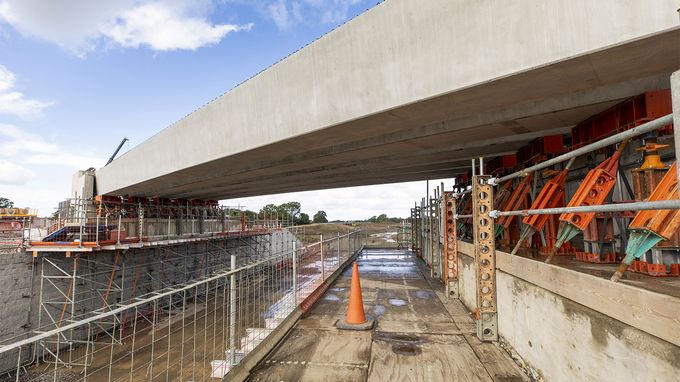
HS2 Ltd
At a glance. On HS2 phase 1 main works civils contract C23, near Quainton in Buckinghamshire, the team replaced a Network Rail overbridge. The original design used fully integral reinforced-concrete abutments and wing walls on deep piles. The adopted alternative used reinforced-soil abutments (featuring polymer geogrids) and wing walls on shallow foundations. The work spanned design, value engineering and construction. HS2 was the client and a joint venture between Eiffage, Kier, Ferrovial Construction and BAM Nuttall (EKFB) was the main works contractor. Arcadis Setec COWI was the designer and specialist input came from Tensar, Coffey Geotechnics and Geofem.
The productivity challenge. The original design required 55 large-diameter reinforced-concrete piles up to 23m deep, with extensive formwork, heavy reinforcement and long curing periods. That meant long construction durations; high embodied carbon; complex sequencing and access constraints; and risks associated with installing deep foundations in Oxford clay. The team set out to reduce programme duration, complexity, cost and carbon impact while maintaining structural performance over a 120-year design life.
What was done. A collaborative value engineering exercise identified that the ground conditions allowed a shallow-foundation solution if unsuitable soils were replaced – and that a reinforced-soil system could eliminate piling. The team excavated 3.7m of unsuitable alluvial soil, replaced it with granular fill and built near-vertical reinforced-soil walls using modular blocks and geogrids, supporting the bankseat directly on the reinforced-soil structure. UK-made components and dry-laid construction eliminated curing time, formwork and reinforcement cages. Finite-element analysis was used throughout to assure performance and build confidence in a non-traditional solution. The decisive enabling factor was a collaborative culture in which the default solution could be challenged and specialist suppliers empowered to lead on the alternative design.
Outcomes. The reinforced-soil solution delivered a 66% reduction in embodied carbon (663t of CO₂e versus 2,002t of CO₂e for the original piled option) alongside a 33% cost saving and significant (unquantified) programme savings from eliminating piling, curing and formwork. Finite-element analysis confirmed acceptable settlement (28mm vertical, 13mm horizontal) and geogrid strains below 1% over the design life. Qualitatively, the team noted reduced construction risk; improved safety from removing deep excavation and heavy lifting; reduced site congestion and fewer movements of spoil and concrete; and greater use of UK-made materials.
Lessons learnt. Reinforced-soil abutments are a viable alternative to piled reinforced-concrete structures, even in major rail applications. Early engagement with specialist suppliers unlocks the largest gains. Finite-element analysis is what builds confidence in non-traditional solutions. Modular systems reduce programme risk and improve flow.
Mapping to PAS 4010. An SPM would have highlighted piling as a major productivity constraint at the optioneering stage (clause 4.1). The reinforced-soil alternative is a textbook application of the “switch” tier of the improvement hierarchy and of value engineering (clause 4.1.1). The collaborative, challenge-positive culture exemplifies the leadership requirements (clause 4.3). The early engagement of specialist suppliers reflects the specification’s procurement and design-stage duties (clauses 5 and 6.3). The carbon and cost analysis embodies the effectiveness and efficiency definitions at the heart of PAS 4010 (clause 0.2).
11.2 Transport case study: East Riding Live Labs 2 – removing street lighting from high-speed roads through intuitive visual design

Karl Rourke
At a glance. Funded by the Department for Transport (DfT) under ADEPT’s Live Labs 2 programme, East Riding of Yorkshire Council led nine partner authorities in testing whether street lighting could be safely removed from high-speed corridors and “conflict zones” – roundabouts, junctions and crossroads – and replaced with passive visual guidance. The work spanned need analysis, design, delivery and live operation across 17 test sites on the A1079 and A164, alongside partner sites nationwide. Partners included Local Transport Projects (road safety and design), the University of Leeds (carbon and cost modelling) and Transoft Solutions (AI monitoring). The project received £3.24m from the DfT and about £2m of partner match funding.
The productivity challenge. Every year, the UK’s 7.2 million streetlights cost more than £1bn in energy and emit a million-plus tonnes of CO₂. The sector’s default response for a decade had been to retain the lighting but switch to LED bulbs: an “improve” choice that left the asset, and most of its whole-life cost and carbon impact, in place. This prompted the council to ask: is lighting really needed on the high-speed corridors and conflict zones that existing guidance says must be lit? Answering this question credibly meant overturning a deeply held safety assumption and producing evidence robust enough for a risk-averse sector to act on.
What was done. The project worked the productivity improvement hierarchy in order:
- Avoid. Each site underwent a National Highways GG 104 safety risk assessment and 10-year collision review. Lighting was removed where the evidence supported that intervention. Three roundabouts were kept lit because their geometry warranted it.
- Switch. In places where visual guidance was still needed, grid-powered lighting gave way to passive and solar alternatives: solar road studs, retroreflective signs and high-performance markings.
- Improve. Where pedestrians genuinely needed lighting, it was retained but improved through the use of footway-only columns made of 80% recycled aluminium, mounted at 3m to eliminate light spillage on to the roadway. A decision tool built with the university compared options over the whole asset life. To assess this solution’s safety performance, a bespoke thermal-imaging AI system tracked driver behaviour and near misses.
Outcomes. Over the 10-year assessment period, the designs cut CO₂ emissions by 25% against like-for-like replacements, improving to 36% with value engineering, and saved £1.24m. Three-quarters of the sites recorded reduced speeds – more than 10% lower for motorcyclists in one location – and the number of night-time collisions fell even as the wider area’s total rose. Removing carriageway lighting and providing a single lit crossing of the A1079 in the village of Hayton incentivised pedestrians to cross the road at this point after dark rather than elsewhere along that stretch. Such findings have been influential: the Institution of Lighting Professionals (ILP) is preparing technical guidance and the BSI is exploring the principles for future standards.
Lessons learnt. The largest gains came from reframing the need, not optimising the default solution. Robust evidence, including risk assessment, live monitoring and whole-life modelling, makes an “avoid” intervention credible in a risk-averse sector. The project showed that the right answer is rarely uniform – avoid wherever possible, switch if necessary and improve if there’s a compelling case. The team also learnt to base whole-life comparisons on the shortest-lived asset, revisiting the decision at each replacement point rather than fixing a 40-year case at the outset.
Mapping to PAS 4010. Reframing the need is applying “avoid” at the stage of greatest leverage (clauses 6.2.2 and 4.1). The passive and solar lighting alternatives exemplify “switch” and the low-carbon pedestrian columns exemplify “improve” (clause 4.1.1), making this a rare instance of the full hierarchy’s application in one scheme. The decision tool and its transparent treatment of uncertain baselines reflect PAS 4010’s target- and baseline-setting duties (clauses 7.1 and 7.1.2). The live AI monitoring embodies its data and measurement requirements (clause 7.2), while the cross-authority learning now informing ILP and BSI guidance exemplifies continuous improvement (clause 8). Throughout, carbon, cost and safety performance improved together – illustrating the specification’s definition of productivity as effectiveness plus efficiency (clause 0.2).
11.3 Water case study: Anglian Water’s Strategic Pipeline Alliance – applying the productivity improvement hierarchy across a regional transfer network

Anglian Water
At a glance. Anglian Water’s Strategic Pipeline Alliance (SPA) is delivering the first phase of a region-wide interconnector. The scheme will comprise 320km of large-diameter pipeline, new pumping stations and storage facilities to move up to 55 million litres daily from the north of the region to the water-stressed south and east, reducing the company’s reliance on environmentally sensitive abstraction. Formed on Project 13’s progressive alliancing principles in 2020, the SPA brings five partners – Anglian Water, Costain, Farrans, Jacobs and Mott MacDonald Bentley – into integrated teams assembled on a “best for task” basis. Their work spans need and optioneering, design, procurement and construction, with PAS 2080 carbon management a core design parameter.
The productivity challenge. The region served by Anglian Water is one of the driest in the UK and has one of the country’s fastest-growing populations. It faces a projected supply-demand deficit of 593 million litres a day by 2050. Tackling a problem of this scale risked locking vast amounts of capital carbon and cost into pipelines, earthworks and concrete structures, against the company’s commitment to cut the greenhouse gas emissions of its capital works by 65% from a 2010 baseline. The task was to build the network the region needs while cutting carbon and cost together, rather than trading one against the other.
What was done. The SPA treated carbon and cost as early decisions, taken through structured optioneering at defined decision points. It applied the productivity improvement hierarchy in sequence:
- Avoid. Integrating new infrastructure with existing assets cut the amount of new storage required by 28%. Optimising routes with the aid of digital terrain modelling reduced the total length of pipeline needed by 88km. Re-using excavated material as pipe bedding spared 83,500m³ of virgin aggregate.
- Switch. After an assessment of material options, carbon-intensive ductile iron was replaced with steel and high-density polyethylene, while concrete mixes containing 50% GGBS displaced higher-carbon alternatives.
- Improve. Lower-carbon construction methods were used wherever practical. Trenchless installation techniques, reduced excavation and optimised wall thicknesses all reduced the carbon impact of the completed assets. A shared carbon model and database kept comparisons consistent, while the integrated team structure enabled faster and better-informed decisions.
Outcomes. The alliance identified more than 200,000t of CO₂e in capital-carbon savings, roughly 30% of which came from optimising routes and 31% from switching pipe materials. By May 2026, with the design stage more than 95% complete and construction 85% complete, the 65% capital-carbon reduction target against the 2010 baseline had been met, with cost reduced alongside it. The target for phase two has since been raised to 70%.
Lessons learnt. CO₂ emissions fell fastest when they were considered alongside cost, safety and time, rather than as a separate discussion. SPA therefore folded carbon management into its register of risks and opportunities. It learnt to look beyond the design of assets and consider how they were built, including through a fuel transition plan aimed at creating diesel-free sites. It also found that sharing performance data had a motivational effect on teams. Retaining the alliance structure in phase two carries this learning forward.
Mapping to PAS 4010. The SPA programme is another example of the productivity improvement hierarchy in action. Its reframing of the need is an application of “avoid” at the stage of greatest leverage (clauses 6.2.2 and 4.1). Its choices of lower-carbon materials and more refined construction methods exemplify “switch” and “improve” respectively (clause 4.1.1). The scheme’s approach to carbon management reflects PAS 4010’s target- and baseline-setting duties (clauses 7.1 and 7.1.2). The learning carried into phase two exemplifies continuous improvement (clause 8). Throughout, carbon, cost and safety performance improved together – illustrating the specification’s definition of productivity as effectiveness plus efficiency (clause 0.2).
Section 12
Demonstrating conformity with PAS 4010
How can an organisation demonstrate conformity with PAS 4010 and say so publicly? In principle, its conformity is established by assessment against the specification’s requirements, as with any other management standard. PAS 4010 deliberately leaves the detail to established assessment practice.
This question matters because a credible conformity claim is one of the most visible ways to show leadership on productivity – and clients are increasingly using it as a differentiator in supplier selection.
This section explains the three routes to a claim, what good supporting evidence looks like and how a claim should be worded.
12.1 Why a conformity claim is worth making
The precedent is PAS 2080. Collective client commitment, backed by visible certification, aided its widespread adoption. Once major clients began achieving and publicising conformity, a consistent expectation spread throughout the supply chain.
HS2 made early and prominent use of this approach: in November 2020 it became the first infrastructure owner in the UK transport sector to achieve PAS 2080 accreditation, signalling its leadership on decarbonisation and encouraging its suppliers to innovate.
A PAS 4010 conformity claim offers the same mechanism for productivity: a clear, externally recognisable statement that an organisation manages productivity to a defined standard. For infrastructure owners, it reinforces the ICG client commitments set out in section 6.1. For suppliers, it is a selling point when bidding for work.
12.2 Three routes to a claim
Conformity with specifications is normally claimed via one of three routes, which differ in the degree of independent assurance they carry – and therefore in cost, effort and the confidence that others will place in the claim:
- Accredited third-party certification: via assessment routes to be developed by certification bodies accredited by the United Kingdom Accreditation Service. This will provide the highest level of independent assurance and be the strongest basis for claiming conformity.
- Independent validation: assessment by an independent party that is not formally accredited, such as a trade organisation. The assessor should be able to show that it operates to recognised standards of competence, consistency and impartiality, such as those set out in BS EN ISO/IEC 17065. This sits between the other routes in terms of the level of assurance it provides.
- Self-validation: the organisation demonstrates conformity itself, publishes supporting documentation and stands behind that. This is the most accessible route, but offers the lowest level of assurance. Stakeholders might therefore place less confidence in a self-validated claim. If it is challenged, independent verification could be required.
Whichever route is chosen, the claim should be explicit about its scope and the specific clauses to which conformity is claimed.
12.3 Scope of the claim – and the evidence behind it
Two things make a claim credible: a clearly bounded scope and robust supporting evidence. The first means stating plainly whether the claim covers an organisation, a programme or a single project (overstating the scope is a quick way to lose credibility). The second means showing, clause by clause, how the specification’s requirements have been met.
For a self-validated claim in particular, the supporting documentation should set out:
- the scope of the claim;
- summary evidence against each relevant clause of PAS 4010;
- any caveats regarding gaps in, or limitations of, the available data;
- the key stakeholders and roles involved in managing productivity; and
- any planned actions for further improving productivity management.
Approaches to validating evidence and presenting conformity claims can be drawn from established assurance standards such as BS EN ISO 14064-3 and BS EN ISO 14021.
The encouraging point is that an organisation running an SPM as described in section 5 has already produced most of this evidence. The SPM’s objectives, analysis of productivity drivers, plan, targets and baselines, monitoring records and learning logs map directly on to the clauses that a claim must address.
Making a conformity claim is therefore largely a case of distilling what an effective SPM generates as a matter of course. Treating the SPM as the evidence base from the outset makes any future claim far less onerous.
12.4 Wording a claim
However conformity is assured, a claim should be clear about who is claiming, for what, in which role and on what basis.
A simple, consistent form of words works well. For example, a client might state:
“Productivity management process for [asset or programme], implemented as asset owner by [organisation] in accordance with PAS 4010.”
That could be followed by the basis of the claim: “Certified by [certification body]”, “validated by [validation body]” or “self-validated”, as appropriate.
Other parties can take the same approach by substituting their role and the corresponding scope of work. Keeping to a recognisable form such as this makes claims easy to compare across organisations and harder to misread, much as standardised PAS 2080 conformity claims have become familiar across the infrastructure sector.
Section 13
Related standards and guidance
PAS 4010 was written to fit into the landscape, not to crowd it. Productivity does not belong in a silo any more than safety, quality or carbon management do. The specification is deliberately designed to sit alongside the systems and frameworks that most infrastructure organisations use. Understanding those relationships allows PAS 4010 to be integrated efficiently rather than bolted on.
ISO 55001 (Asset management). The ISO 55000 series sets out how to manage assets for value, balancing cost, risk and performance. ISO 55001 defines the strategic framework for managing a portfolio of assets, whereas PAS 4010 supplies the delivery-stage productivity discipline that helps to achieve the strategic objectives set within that framework. The two standards are complementary, with no conflict between them.
PAS 2080 (Carbon management in buildings and infrastructure). This is PAS 4010’s closest relative – and not by accident – sharing much of its structure and logic. The two reinforce each other directly. The productivity improvement hierarchy at the heart of PAS 4010 mirrors the carbon hierarchy in PAS 2080, with decisions improving whole-life productivity often reducing whole-life CO₂ emissions too. Teams fluent in PAS 2080 will find PAS 4010 familiar. The two can be managed with one set of governance and reporting arrangements.
BS EN ISO 9001 (Quality management systems), BS EN ISO 14001 (Environmental management systems) and BS EN ISO 45001 (Occupational health and safety management systems). These three standards share a common architecture in terms of leadership, governance, process discipline and continual improvement. PAS 4010 is built to align with them, so that productivity management can be embedded in the same assurance structures they use, rather than running in parallel.
BS 99001 (Quality management systems standard for the built environment). This built-environment-specific application of BS EN ISO 9001 sits alongside the general quality standard referenced above, translating its requirements into construction-sector practice. PAS 4010’s productivity discipline complements the assurance that BS 99001 provides, so that improving productivity does not come at the expense of quality.
BS EN ISO 19650 (Managing information with building information modelling). Good productivity management depends on timely, accurate, accessible information. PAS 4010 aligns with ISO 19650’s approach to information management so that data-sharing, digital assurance and collaborative planning all pull in the same direction.
BS EN ISO/IEC 42001 (AI management system). As artificial intelligence starts to support planning, optimisation and assurance in delivery, this newer standard provides the management framework for using the technology responsibly. PAS 4010’s data and governance requirements are designed to be compatible with it, which matters as more teams adopt AI-enabled productivity tools.
PAS 440 (Responsible innovation). This standard sets out a framework for identifying and managing the wider risks and impacts of innovative products, processes and technologies. Where PAS 4010 creates the conditions for productivity-driven innovation to be adopted with confidence, PAS 440 helps teams to assess whether a given innovation is being introduced responsibly.
GovS 002 (Project delivery). This standard sets mandatory expectations for public bodies on planning, governance, risk management and assurance. PAS 4010 supports these directly, offering a structured productivity discipline that slots into the delivery frameworks that government organisations already use.
The Construction Leadership Council’s Creating a Productive Environment for UK Construction. This 2023 strategy document sets out a plan to boost UK construction productivity by up to 25%, with focus areas including planning reforms, collaborative working and industrialised construction.
The Project 13 Infrastructure Governance Code. This 2023 code sets out principles for the governance of infrastructure, organised into six themes. It states how infrastructure should be governed for better outcomes, while PAS 4010 supplies the productivity management discipline that operates within that governance framework.
HM Treasury’s and NISTA’s UK Infrastructure: A 10 Year Strategy. The National Infrastructure and Service Transformation Authority (NISTA), formed in 2025 from the merger of the National Infrastructure Commission and the Infrastructure and Projects Authority, leads the effort to transform how the UK plans and delivers infrastructure. This ambition is underpinned by the government’s 10-year infrastructure strategy and its commitment to invest at least £725bn in infrastructure by 2035. NISTA’s emphasis on systems thinking, whole-life value and improved delivery aligns closely with the objectives of an SPM at project and programme level. Adopting PAS 4010 is one practical way for an organisation to demonstrate that it’s working to realise the strategy’s ambitions.
The NISTA/IPA Project Routemap. Developed by the Infrastructure and Projects Authority and maintained by its successor, NISTA, this is the government’s method for establishing novel or complex projects, covering set-up and procurement decisions before delivery. Where the routemap helps a team to establish a project on a sound footing, PAS 4010 supplies the productivity management discipline the team can then apply throughout the design, procurement and delivery phases.
Government Project Delivery’s Programme and project data standard. This sets consistent definitions, formats and quality expectations for core programme and project data – covering features, risks, issues, benefits, milestones, costs and people – so that data is interoperable and comparable across government departments. Its data requirements align with those of PAS 4010.
Other complementary industry initiatives. Several industry-led programmes tackle related aspects of the same productivity challenge. PAS 4010 is designed to sit alongside them rather than duplicate them. The Get It Right Initiative provides guidance and training on how to reduce error and eliminate the waste it causes across the sector – a close relative of the “least waste” principle in PAS 4010’s productivity definition. Buildoffsite promotes offsite manufacture and modern methods of construction.
Collectively, all these standards and frameworks form a coherent ecosystem. PAS 4010 does not replace any of them; it strengthens them by treating productivity as a core discipline that deserves the same systematic approach we already apply to safety, quality, carbon and information management.
Annexes and templates
These annexes are working tools, intended to be lifted out and used directly on live programmes. Deliberately simple and non-prescriptive, they should be tailored to the project’s sector, scale and complexity.
Annexe A1
The 11 key drivers of value for money on infrastructure projects
Developed through the ICG productivity workstream. Reproduced with thanks.
The following 11 factors affect the cost, productivity and outcomes of major projects, as identified by the ICG’s productivity workstream. They form the basis of a practical checklist for the analysis of productivity drivers covered in section 4.3. Working through these drivers in a workshop helps a project team to identify where value, cost and waste are really being generated, from the early choices that have the most influence through to the cultural factors that shape delivery.
Some of the 11 map directly on to themes elsewhere in this guidance. The driver labelled “culture and behaviours” in the table below relates to matters discussed in section 4.8, for instance.
| Driver | What it is | Why it matters for value for money |
|---|---|---|
| 1. Requirements | The specified outputs and outcomes defining what the asset must deliver throughout its life | Clear, stable and proportionate requirements are fundamental: they let the asset deliver its outcomes efficiently and avoid over-specification, late changes and cost–benefit misalignment |
| 2. Constraints | External factors the project cannot directly control: physical, logistical, regulatory, environmental, operational, political, funding or stakeholder | Understanding and actively managing constraints shapes realistic strategies and prevents avoidable risks, delays and lost benefits |
| 3. Concept design | The strategic design solution that meets all requirements and addresses the constraints effectively | Early design decisions fix a large share of whole-life value and risk; strong concept design aligns form, function and constructability with long-term performance |
| 4. Construction strategy | The design of the production system: overall sequence, logistics, key plant and production control | A good construction strategy improves flow, reliability, safety and predictability, reducing variability and delivery time |
| 5. Organisational and commercial model | The organisational and commercial arrangements covering the client, suppliers and stakeholders: roles, accountabilities, decision rights, interfaces and contracts | Clear governance and aligned incentives enable timely, outcome-focused decisions and programme-level optimisation rather than local trade-offs |
| 6. Detailed design | The complete technical spec needed for procurement, construction, commissioning, operation and maintenance: drawings, specifications, models and plans | High-quality detailed design enables efficient construction, right-first-time delivery and long-term maintainability |
| 7. Construction efficiency | The efficiency of the production system: detailed production planning, workflow optimisation, production control and continual improvement | Efficient delivery maximises productive time, stabilises workflow and reduces waste, improving productivity, safety and confidence |
| 8. Error reduction | Systematic elimination of error: process non-compliance that causes waste, defects and rework | Fewer errors mean less rework and disruption, with effort focused on value-adding activity rather than correction |
| 9. Disruption | External or internal events that disrupt delivery: pandemics, regulatory reform, leadership changes, funding cuts or strategic redirection | Reducing, absorbing and adapting to disruption protects continuity and intended outcomes while avoiding costly recovery |
| 10. Culture and behaviours | Trust, collaboration, psychological safety, a learning mindset, a challenge culture and ethical transparency across all parties and boundaries | Positive culture underpins better decisions, faster problem-solving and continuous improvement, while enabling innovation and system-wide optimisation |
| 11. Organisational friction | Resistance to efficient progress from excessive bureaucracy and inadequate or misapplied tools – e.g. excessive assurance and reporting | Reducing friction speeds up decisions, improves flow and prevents the loss of productive effort |
Annexe A2
Five levers for enabling productivity
This offers an alternative, role-based approach to finding productivity opportunities, moving from client-level programme decisions down to individual site-operative tasks. It complements, rather than replaces, the productivity management hierarchy in section 2 and the 11 drivers in annexe A1. Where those set out what to prioritise and why, this identifies who is typically responsible for key productivity choices at each level and what a productivity discussion with them might cover. It is an initial framework, offered here for teams to test and adapt rather than as a finished, validated model.
| Role | Lever | Drivers | Measures of improvement |
|---|---|---|---|
| Client | Work packaging |
|
|
| Designer | Design for high productivity |
|
|
| Contractor | Deep supply-chain engagement |
|
|
| Workfront, crew planning and logistics |
|
| |
| Site-operative efficiency |
|
|
Annexe A3
Monitoring examples
A balanced monitoring set usually combines leading indicators (early signals you can act on) with lagging ones (results that confirm performance). Common measures include:
- Direct and indirect cost ratio: direct and indirect costs as a proportion of total cost – the “pound in the ground” set against the cost of supervision, overheads and preliminaries. A high or rising indirect share is a strong signal of productivity lost to inefficiency.
- Quality at gateways: measures of right-first-time quality at key control points – the completeness of design at each gateway; the proportion of activities passing readiness reviews; and construction certification or first-time acceptance rates – so that quality is confirmed before work proceeds rather than corrected afterwards.
- Percent plan complete (PPC): the proportion of planned tasks finished – often the earliest signal of an emerging flow problem.
- Rework: the volume or cost of work that had to be redone – a direct measure of waste.
- Labour and plant utilisation: how productively people and equipment are being deployed.
- Production rates: output per unit of time – e.g. metres of pipe laid each day.
- Design cycle times: how long design information takes to flow and how much remains outstanding.
Annexe A4
PAS 4010 competency framework
This framework sets out the knowledge, skills and behaviours needed to apply PAS 4010 effectively. It helps organisations to assess capabilities, identify gaps and plan training, providing a common language for productivity management roles across the value chain. It is intentionally non-prescriptive and should be tailored to organisational context, delivery model and project scale.
At competency levels 2 and 3 (practitioner and leader), competence is not solely a matter of technical know-how. It also calls for judgement, stewardship and behavioural discipline, such as honest reporting, managing interdependencies and creating the psychological safety that allows people to raise concerns early. These behaviours underpin the reliability of the SPM and are key to delivering the intent of the specification.
Competency levels
Level 1: awareness. Understands the purpose and principles of PAS 4010 and the SPM; recognises productivity drivers and constraints; understands their own contribution; and follows established processes. Typical roles: early-career practitioners, graduates, site supervisors, junior designers, assistant project managers.
Level 2: practitioner. Applies PAS 4010 within their discipline; contributes to the SPM; identifies risks and opportunities; uses productivity data to inform decisions; and participates in collaborative planning and readiness reviews. Typical roles: project and package managers, discipline leads, planners, commercial and design managers.
Level 3: leader. Leads the development and implementation of the SPM; sets objectives and targets; establishes governance, information flows and appropriate behaviours; assures performance; and champions learning and capability. Typical roles: client sponsors, programme directors, senior project managers, heads of function, senior designers and contractors.
Competency areas by level
| Competency area | Awareness (L1) | Practitioner (L2) | Leader (L3) |
|---|---|---|---|
| Understanding productivity | Understands effectiveness and efficiency; recognises common forms of waste | Identifies productivity drivers and constraints in their discipline; applies productivity principles | Shapes productivity strategy; leads systemic analysis; embeds productivity in decisions |
| Applying PAS 4010 | Understands the structure; follows data, reporting and planning processes | Applies requirements in their scope; contributes to the SPM; ensures clause compliance | Owns and assures the SPM; embeds it in governance and procurement; ensures proportionate application |
| Collaborative planning | Participates in planning; understands principles of reliable planning | Leads discipline-level planning; uses data to improve reliability | Establishes collaborative planning systems; governs flow at programme level |
| Data, targets and monitoring | Understands key indicators; collects and reports data accurately | Sets discipline-level targets and baselines; interprets data for trends and risks | Sets programme targets; ensures data quality and assurance; drives strategic decisions |
| Leadership and culture | Open and willing to learn; raises issues constructively | Encourages collaboration and psychological safety; facilitates learning reviews | Sets cultural expectations; leads by example on transparency and constructive challenge; embeds learning systems |
| Continuous improvement | Participates in learning reviews; applies improvements in their work | Leads discipline-level improvement; ensures that lessons are identified and shared | Establishes improvement frameworks; ensures that learning informs future projects; champions innovation |
Indicative role profiles
The matrix below shows the level typically expected of each role across the six competency areas. It is a starting point for capability assessment, not a rigid prescription.
| Competency area | Client/sponsor | Designer | Contractor | Subcontractor/supplier |
|---|---|---|---|---|
| Understanding productivity | 3 | 2 | 2-3 | 1-2 |
| Applying PAS 4010 | 3 | 2 | 2 | 1-2 |
| Collaborative planning | 2-3 | 2 | 3 | 2 |
| Data, targets and monitoring | 3 | 1-2 | 2-3 | 1-2 |
| Leadership and culture | 3 | 1-2 | 2 | 1 |
| Continuous improvement | 3 | 2 | 2-3 | 1-2 |
Organisations can use this framework to assess current capabilities; identify gaps; design training and development pathways; support procurement and supplier evaluation; align roles with PAS 4010 expectations; and build a consistent approach across programmes.
Contributors
This guidance has been written by PAS 4010’s technical author:
Mark Hansford, Mark Hansford Consulting
The ICE thanks the members of the PAS 4010 technical advisory panel for their contributions to the development of both the standard and the guidance:
Andy Alder, Anglian Water
David Coles, Department for Transport
Olivia Jenkinson, Department for Transport
Ed McCann, Expedition Engineering
Martin Perks, Black Pear Advisory
Mike Pittman, Department for Transport
Paul Sheffield, ICE past president 2019-20
The institution also acknowledges the valuable contributions of the PAS 4010 steering group.
We are grateful to our sponsors, the Department for Transport and the Infrastructure Client Group, for supporting the production of this guidance.

ICE team:
Sam Gould, director of policy and external affairs
Alex Wynne, knowledge programmes director
Hannah Besford, knowledge programmes lead
James Brockett, knowledge editorial specialist
David Stewart, engineering specialist
Amanda Rice, climate programme specialist
Editorial production: Michelle Harbi, Neil Cole, Mark Robson
Design: James McCarthy, Paul Weston